Non-Native Tree Storm Hazards in Coastal Communities
The native coastal habitats of California have evolved to withstand winter storms. Within the ecological and geomorphological zones of the Coast Ranges, marine terraces, dune systems, estuaries, riparian zones, coastal ravines and valleys, and nearshore environments, plant species and communities such as Coastal Scrub types, Coastal Prairie, wetland, and coastal evergreen forest types are generally long-lived perennial ecosystems, which exhibit elastic, low profile physical traits.
Within the more protected valleys, ravines, and slopes of the Coast Ranges, robust stands of Redwood, Oak, Bay, Doug Fir, Pine, Alder, and other taller forest tree species can be found in their sheltered native ranges.
Relatively recently, the concerted importation, planting, and spread of non-native invasive tree species in California began in earnest in the mid-19th century, along with the invasion and colonization of California by settlers during and post Gold Rush. Numerous invasive tree species, such as Blue gum Eucalyptus (Eucalyptus globulus) did not evolve with, and are not adapted to California’s geography and ecosystems; outliving and overgrowing the absent natural checks and balances of their native homelands, leading to the destruction of California’s native habitats and human environments.
The arcing trajectory of the rapid growth and deterioration of these 19th century invasive tree stands in our coastal habitats and communities is plainly visible within our current lifetimes.

Eucalyptus globulus:
Early colonizers commonly observed California’s unique coastal Mediterranean habitats of scrub, prairie, chaparral, dune systems, wetlands, and low profile forest, as barren and lacking fertility. Invasive, non-native tree species such as the Australian blue gum, Eucalyptus globulus, were planted massively up and down the coastal regions of the state in an effort to create wind blocks, produce hardwood for lumber production, and for esthetic appeal.
Centuries of widespread ecological destruction to California’s coastal native habitats impacted by the rapid growth of Eucalyptus globulus, would follow. Massive, fast growing, weedy stands of thirsty Eucalyptus, emitting toxic oils from its shedding foliage, began to plague fragile coastal ecosystems, absorbing and poisoning waterways, and displacing and exterminating native plants, invertebrates, and animals.
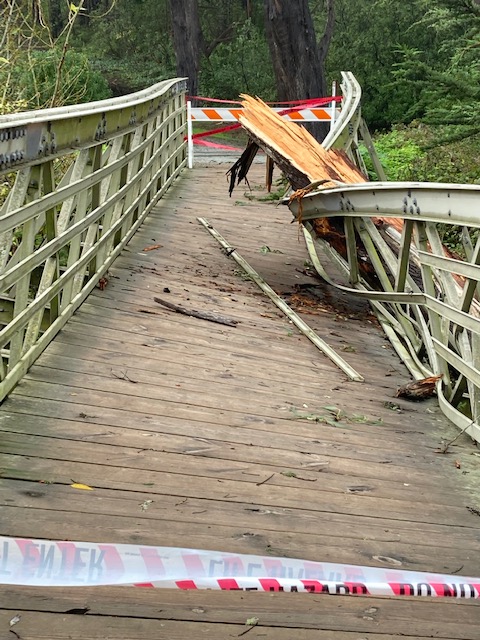
In recent decades Eucalyptus globulus stands have gained popular attention and recognition as a serious fire hazard to humans and the built environment in arid, drought-prone California. Eucalyptus are also a serious hazard to human safety and the built environment during California’s intermittent wet winter years. As in El Nino and stormy winters of the past decades, the La Nina storms of January of 2023 have produced numerous destructive tree falls on to buildings, passenger vehicles, roadways and power infrastructure.
Structural failure of Eucalyptus globulus most often occurs in stands over 50 years of age, and is commonly associated with “root failure,” meaning the entire tree topples from its base. Structural failure of Eucalyptus globulus also often involves the breakage of its extremely heavy lateral limbs.
In California, the range of Eucalyptus globulus extends along the entire coast from south to north, favoring the Los Angeles basin, the Central Coast throughout the San Francisco Bay Area, and extending inland throughout the Central Valley.
The Ecological Quandary of the Monterey Cypress:
While Monterey Cypress, Hesperocyparis macrocarpa, is a rare and endangered native California species in its tiny endemic range, which consists of just two native stands at the north and south ends of Carmel Bay in Monterey County on the central California coast; it is also considered a moderately invasive and weedy species directly outside of its native range up and down the coast of California, and in pockets around the world, from the central Hawaiian Islands to New Zealand, England, and beyond.
Emblematic of California’s wild majestic and windswept coast, Monterey cypress was first outplanted by settlers and ranchers in the 19th century as wind breaks, hedge rows, and continued as aesthetic plantings in parks, golf courses, and public as well as private coastal properties. These stands quickly grow to dense, dark, weedy and crumbling groves, shedding woody debris and plant material that excludes native understory growth outside of their immediate endemic range.
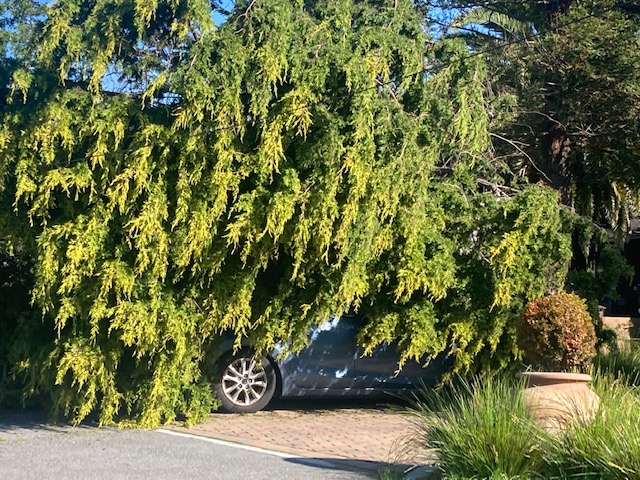
In coastal California, Monterey cypress stands over 25 years old experience high tree failure rates due to heavy crowns and very heavy large lateral limb breaks, in the stormy months of October through January.
Resources and Further Reading:
Hazardous Trees Permit Exemption, San Mateo County
Eucalyptus globulus:
Cal IPC Plant Report: Eucalyptus globulus
Calflora Taxon Report: Eucalyptus globulus
Structural Failure Profile: Eucalyptus globulus – UCANR
Eucalyptus globulus: A Complex Challenge – NPS Management Information
History of Eucalyptus in California – KQED
Eucalyptus Fire Hazards Management Information: Eucalyptus Globulus – Fire Safe Marin
Hesperocyparis macrocarpa:
Cal IPC Plant Report: Monterey Cypress
Calflora Taxon Report: Hesperocyparis macrocarpa
Structural Failure Profile: Hesperocyparis macrocarpa – UCANR
Monterey Cypress Distribution and Occurrence – USDA
Monterey Cypress Botanical and Ecological Characteristics – USDA
Site Impacts and Invasive Species Associations of Monterey Cypress – CNPS Marin County
Site Impacts and Invasive Species Associations of Monterey Cypress – CNPS San Mateo County
Invasive Plant Atlas, Monterey cypress in Hawaii
National Biodiversity Network, Monterey cypress in England
Becerra, P., J. Catford, et al. 2017. “Inhibitory effects of Eucalyptus globulus on understory plant growth and species richness are greater in non-native regions.” Global Ecology and Biogeography: 27(1): 68-76. doi abs/10.1111/geb.12676
Martins, C., T. Natal da Luz, et al. 2013. “Effects of essential oils from Eucalyptus globulus leaves on soil organisms involved in leaf degradation.” Plos One 8(4). doi 10.1371/journal.pone.0061233
Mcfadden, Kelly. 2021. “Understory vegetation composition and small mammal abundance in an exotic eucalyptus forest vs adjacent native habitat.” Master of Science in Environmental Sciences and Management, California Polytechnic State University, San Luis Obispo
Discover more from Cal Geographic
Subscribe to get the latest posts sent to your email.
