
Biogeography of California’s Seasonal Freshwater Wetlands
For the purpose of this research, and to get a better understanding of this overwhelming and ecologically vital topic, I have grouped California’s seasonal (vernal, ephemeral) freshwater wetlands into three categories, or associations, based on broad geomorphological distinctions, and differing hydrologic characteristics: coastal seasonal freshwater meadows; valley hardpan vernal pools; and backdune/interdunal seasonal freshwater wetlands. One defining factor all seasonal wetlands have in common is California’s wet-dry cycle Mediterranean climate, which has produced the extreme seasonality these ephemeral ecosystems have so beautifully adapted to.
In this summary I am analyzing the biogeography of these three associations. I investigate the physical character and geomorphology of each of these wetland types in the accompanying summary, Geomorphology of California’s Seasonal Freshwater Wetlands – with the addition of sag ponds.
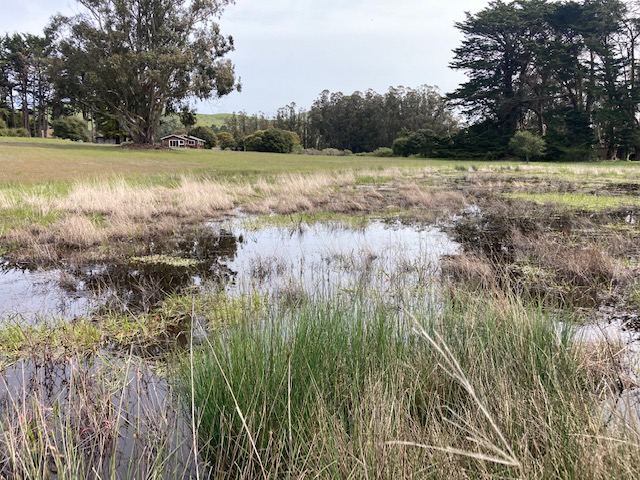
Coastal Seasonal Freshwater Wet Meadows and Swales
Geography:
Once found widespread across marine terraces and lowlands of California’s coastline and Coastal Ranges, coastal seasonal (vernal) freshwater wet meadows and swales are arguably the most overlooked, underappreciated, understudied, and endangered freshwater wetland types in the state. Once abundant, coastal seasonal wet meadows and swales were (and are) key ecosystem components within the highly endangered coastal scrub and coastal prairie systems of the West Coast. Overwhelmingly impacted by human disturbance and development, coastal seasonal wet meadows have been eliminated by an estimated 98%.
Coastal seasonal wet meadows and swales are universally ignored on spatial analyses and maps of freshwater wetlands of California’s geomorphic provinces. The most detailed visualizations of the state’s wetland zones always leaves the entire strip of coast from Humboldt to Point Conception as devoid of freshwater wetlands. One USGS National Water Summary of California’s Wetlands from 1995 vaguely mentions wetlands of the coastal counties found in the Coast Ranges, and classifies them as “palustrine.”
The most explicit mention of coastal seasonal freshwater wetlands is found within the Cal Department of Fish and Game’s “California Vernal Pool Assessment Report,” (Keeler-Wolf et al, 1998) recognized as the most comprehensive classification and reference treatment of California’s seasonal wetlands. Here, our coastal seasonal freshwater wetlands are noted as, “In order to limit the scope of this document, we have restricted the definition of vernal pools to exclude other ephemeral wetlands. Vernal lakes and other larger intermittent wetlands as well as other more persistent wetlands (with emergent vegetation dominated by taxa of Scirpus, Carex, or Typha) are excluded..”
In contrast to the well-known valley hardpan vernal pools of the Sacramento Valley and elsewhere in the state, which develop and hydrate in wet months by retaining rainwater above an impermeable hardpan or claypan substrate, coastal seasonal wet meadows and swales usually form when high subsurface water tables completely saturate and overflow the more permeable soils of the Franciscan Formation and coastal sandstones in the winter and spring months.
Coastal seasonal freshwater wet meadows and swales are often very shallow, and, as investigated further in our Landforms post, Geomorphology of California’s Seasonal Wetland Types, most often occupy meadows, slight depressions, swales, gullies, and form as sag ponds found within transtensional (divergent/pull-apart) depressions along the San Andreas rift zone, and other transform fault lines. These wetlands usually host herbaceous communities dominated by emergent native perennials of the California coastal regions..
Flora:
As with vernal pools and other seasonal wetland types, the vegetation of coastal seasonal freshwater wetlands emerges and retreats on a seasonal cycle, although usually in a more muted display than the pronounced waxing and waning of Lasthenia and other annual flowers which encircle the valley pothole vernal pools in brilliant and colorful concentric rings. Coastal habitats enjoy more moisture availability than valley and inland habitats by virtue of proximity to the humid ocean air, and delivered via summer coastal advection fog. This allows many moisture loving and wetland plant species to persist throughout the year along the coast, and has encouraged perennial species to dominate the coastal seasonal wetland areas, as opposed to inland valley vernal pool ecosystems, which are dominated by annual vegetation adapted to avoid extremely hot and dry summer drought conditions.

Plant taxa adapted to and commonly found in coastal wet meadows include Juncus, Carex, Scirpus, and Eleocharis species; aquatic and water tolerant grasses such as Alopecurus aequalis, Glyceria leptostachya, and Hordeum brachyantherum; Rumex sp; Stachys adjugoides; Potentilla anserina; Sisyrinchium bellum, and many other species which overlap within the wet meadow/coastal prairie/coastal scrub system.
Although I have only uncovered ONE paper that directly addresses the habitat value and flora of coastal seasonal freshwater wetlands (Reed et al, 2011 – references below), coastal seasonal freshwater wetland plant lists can be pieced together from the links and resources below, and through the Calflora website by searching by species, by community, and through area searches.
Fauna:
The vertebrate and invertebrate fauna of coastal seasonal wet meadows is both fascinating and severely understudied. Where there are moderate to plentiful and accessible resources concerning wetland flora of coastal California, I have found only ONE resource (UC Santa Barbara NCOS vernal pool monitoring link in references below) directly addressing the monitoring of aquatic fauna and macroinvertabrate communities of coastal seasonal freshwater wetlands in California. I have found one report that addresses macroinvertabrate richness in disturbed depressional wetlands in central California (Stein et al, 2017 – references below), but without listing which taxa and species. And I have found one other study covering a comprehensive one-time survey of macroinvertabrate taxa at a vernal pond study site in the Coast Range in Mendocino County (Peterson et al, 2017 – references below). That’s it.
I am not including southern coastal mesa hardpan vernal pools in this category and paucity of research. Much attention has been paid to the rare and threatened fauna of valley hardpan vernal pools, and rightfully so, but the fauna of coastal seasonal freshwater wet meadows and wetlands has been wholly overlooked and under-protected. I fear there is no baseline data for coastal seasonal wetland invertebrate populations, and that we have already lost more than we will know.


Ostrstracods and Pacific Chorus Frog tadpoles, R.Forest
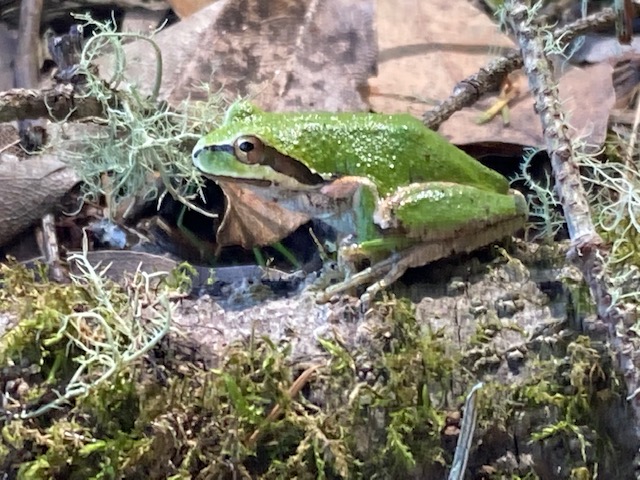
Seasonal wetland organisms tend to be grouped and analyzed as macroinvertabrates, dominant invertebrate predators, and vertebrate predators. Dominant taxa in studies of Coast Ranges macroinvertebrate communities include: Coleoptera; Cyzicus; Diptera; Hemiptera; Limnephilus; Linderiella; Odonata; Ostracoda; Copepods; Crustaceans; Cladocera; Corixidae; Chironomidae. Prominent invertebrates of coastal and Coast Ranges seasonal freshwater wetlands include Pacific newts (Taricha sp), Pacific chorus frog (Pseudacris regilla), and Western garter snakes, (Thamnophis sp).
Seasonal freshwater wetlands are intermittent and temporary aquatic habitats with short inundation phases that vary from year to year. As a result, macroinvertabrates and other aquatic fauna have developed coping strategies to withstand the dry season, including: short reproduction times and high reproductive rates; rapid larval growth; ovarian diapause; desiccation-tolerant eggs (cysts); desiccation-tolerant early larval stages; early emergence to complete the entire life-cycle during the hydrated season; emergence followed by migration to outside perennial wetlands to withstand the dry season. Many vernal pool crustacean species can start reproducing within a few weeks of hatching.
Some naturally occurring and variable abiotic conditions effecting the water chemistry, thus the flora and fauna of coastal seasonal freshwater wetlands, include: water temperature, surface area, pH levels, Alkalinity, dissolved oxygen levels and turbidity within the wetland. Common human-caused stressors on wetlands include inputs and disturbances to the above water quality issues; as well as landscape degradation; habitat alteration; excessive nutrient and metals runoff/sediment load; agricultural practices; and the effects of climate change.
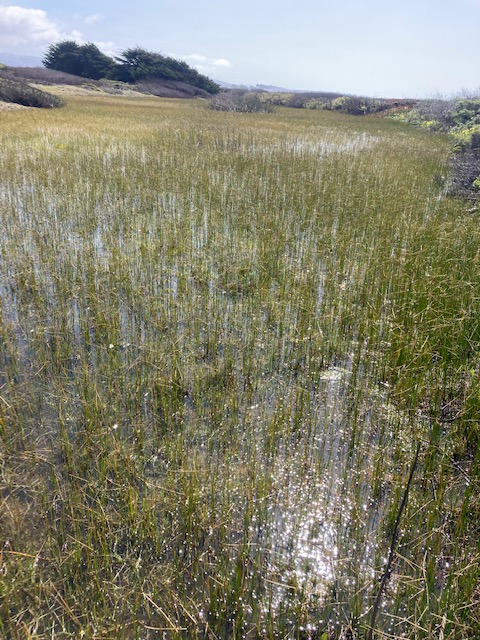
Backdune Seasonal Freshwater Wetlands
Geography:
Backdune, or interdunal seasonal wetlands, are found throughout large coastal dune systems from central Oregon to San Luis Obispo/Santa Barbara Counties in the south. Also called coastal dune swales, backdune and interdunal seasonal wetlands host a unique set of geomorphic and biological components. Backdune and interdunal seasonal wetlands can form in both active and stabilized dune environments.
Well known remnant and protected coastal dune fields in California include Lanphere Dunes of Humboldt Bay National Wildlife Refuge in Humboldt County; the dunes at Fort Ord National Monument and State Park in Monterey County; the Morro Dunes Ecological Reserve in San Luis Obispo County; and Guadalupe-Nipomo Dunes National Wildlife Refuge in San Luis Obispo/Santa Barbara Counties.
Coastal backdune and interdunal seasonal wetlands are exposed to salt spray from ocean winds and wave emissions, as well as salinity in the sandy soils, encouraging salt tolerant/brackish tolerant plant and animal species within these unique communities and habitats.
Flora:
Plant taxa adapted to and commonly found in backdune seasonal freshwater wetlands include Juncus, Carex, Scirpus, and Eleocharis species; Rumex sp; Stachys adjugoides; Sisyrinchium bellum; Salix sp; Distchlis spicata; and others.
At Fort Ord National Monument seasonal freshwater wetlands, locally referred to as vernal pools, have formed in the relict Pleistocene stabilized backdunes amidst a rare maritime chaparral ecosystem. Vernal pools at Fort Ord are also found in coastal scrub, grassland, and oak woodland habitats atop the sandy soils of the stabilized dune system.
An isolated coastal population of the endangered Contra Costa Goldfield (Lasthenia conjugens) is found in a few patches within the Fort Ord vernal pool complex. Dependent on the annual cycle of inundation and desiccation, the goldfields bloom in brilliant mustard rings encircling the pools as they recede and dry up in the spring.
Backdune seasonal freshwater wetland plant lists can be pieced together from the links and resources below, and through the Calflora website by searching by species, by community, and through area searches.


Desiccated backdune seasonal wetland with Typha latifolia, Potentilla anserina, Carex sp., Rumex sp – R.Forest
Fauna:
The backdune seasonal freshwater wetlands at Fort Ord host two well-known rare vernal pool species: the California tiger salamander (Ambystoma californiense), and the California fairy shrimp (Linderiella occidentalis).
The California Tiger Salamander was listed as a federally Threatened species in 2004, and critical habitat to support the salamander’s life cycle was designated in 2005, although Fort Ord was excluded from the designated habitat areas for unnamed economic reasons. California Tiger salamanders rely on vernal pools to breed and lay their eggs, and are closely monitored at Fort Ord.
The California fairy shrimp (Linderiella occidentalis) is a federal species of special concern. The fairy shrimp are surveyed at Fort Ord during the winter and spring vernal pool inundation season.
In past aquatic sampling surveys at Fort Ord several additional macroinvertebrate species were observed, including: Cladocera (water fleas); Copepods; Ostracods; Coleoptera (water beetles and diving beetles); mosquito larvae; Anisoptera (dragonfly larvae); Zygoptera (damselfly larvae); Ephemeroptera (mayfly larvae); amphipods; and Cyzicus (clam shrimp).

Valley Hardpan Vernal Pools
Geography:
Once dominating the plains, grasslands, and upland rims of the Central Valley, valley hardpan vernal pools can still be found in pockets and small complexes across the state. With the majority still occurring in the Central Valley, hardpan vernal pools also occur in the foothills of the Sierra; valleys of the Transverse and Coast Ranges; southern California coastal mesas; and within the Modoc Plateau.
Central Valley hardpan vernal pools commonly form in depressions known as potholes or hog wallows, within the distinctive undulating hummock and hollow topography of mima mounds. The geomorphology and physical geography of valley hardpan vernal pools is explored further in our Landforms post .
Valley vernal pools are defined as ephemeral wetlands with an impervious hardpan or claypan basin, which traps precipitation and is extremely slow draining. Inundation occurs in the winter months followed by evaporation and desiccation in the late spring through fall. Unique to the Mediterranean climate, these distinctive ephemeral wetland habitats have evolved with and adapted to the extremities and unpredictability of the short-wet, and long-hot-dry seasons of the Central Valley and inland California.
The flora and fauna of valley hardpan vernal pools are adapted to tolerate unpredictable hydrologic conditions from year to year, and can complete their entire life cycles in the abbreviated winter and spring inundation and evaporation periods.
It should be noted, as with other seasonal and ephemeral wetland types in California, the dry season, or drought phase, is very important in the cycle of life of the valley hardpan vernal pool ecosystem. Even in this harshest of seasonal wetland environments, biological activity carries-on as invertebrate cysts experience the required desiccation to remain viable; late season grasses and flowering plants flower and set seed; seed eating animals rely-on and visit the pool sites to forage; and other animals visit to feed on them.
Flora:
The majority of vernal pool plants are annuals. In order to survive dry seasons, and the possibility of extreme and prolonged drought, vernal pool specialists have adapted to germinate, flower, set seed, and senesce within a year, or portion thereof. Vernal pool plant species also produce dormant seeds, which can stay viable for many years in the soils until the correct conditions within the vernal pool trigger their growth, such as soil moisture and temperature. Not all seeds will germinate in a single year, providing a safety net savings account to increase the chances of species survival over long periods of time, through prolonged drought, and through local extinction events.
A unique and charismatic feature of vernal pool specialization is the zonation of annual plant species. Signature concentric rings of blooms encircle the vernal pool in the spring as each species takes its turn to display, depending on its tolerance to inundation. Species that are the least tolerant of inundation bloom early on the outer rings of the pool, which evaporate first, and subsequent rings of annual species blooming inside the last, as they are progressively more tolerant of inundation. The most inundation tolerant annuals are last to bloom at the center of the evaporating pool.
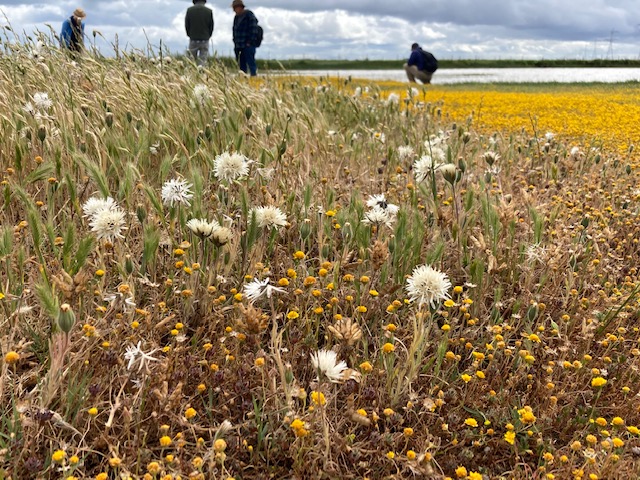
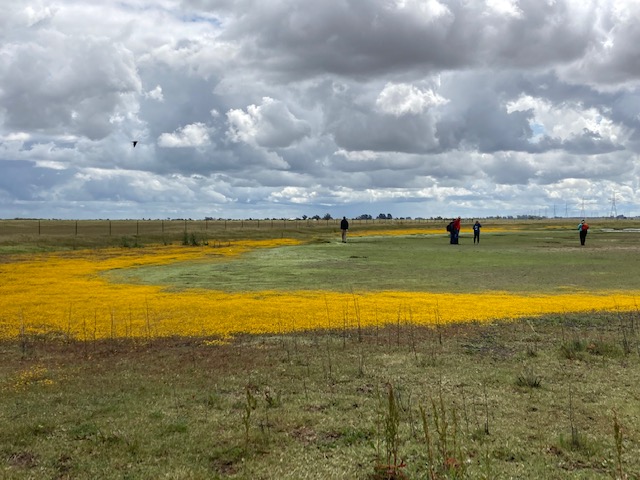
Valley Claypan Vernal Pool flora, R.Forest
Valley hardpan vernal pools, as a habitat type, hosts a high percentage of specialized endemic species, as well as a high number of rare, threatened, and endangered plant species. Federally endangered plants of valley hardpan vernal pools, includes: Eryngium constancei (Loch Lomond button-celery); Lasthenia conjugens (Contra Costa goldfields); Limnanthes floccosa ssp. californica (Butte County meadowfoam; Navarretia leucocephala ssp. pauciflora (few-flowered navarretia); Navarretia leucocephala ssp. plieantha (many-flowered navarretia); Orcuttia pilosa (hairy Orcutt grass); Orcuttia viscida (Sacramento Orcutt grass); Parvisedum leiocarpum (Lake County stonecrop); Tuctoria greenei (Greene’s tuctoria); and Tuctoria mucronata (Solano grass).
Federally threatened plants include: Castilleja campestris ssp. succulenta (fleshy owl’s clover); Chamaesyce hooveri (Hoover’s spurge); Neostapfia colusana (Colusa grass); Orcuttia inaequalis (San Joaquin Valley Orcutt grass); and Orcuttia tenuis (slender Orcutt grass).
Other valley hardpan vernal pool plant species of-concern, include: Astragalus tener var. ferrisiae (Ferris’ milk vetch); Astragalus tener var. tener (alkali milk vetch); Atriplex persistens (persistent-fruited saltscale); Eryngium spinosepalum (spiny-sepaled button-celery); Gratiola heterosepala (Boggs Lake hedgehyssop); Juncus leiospermus var. ahartii (Ahart’s dwarf rush); Legenere limosa (legenere); Myosurus minimus var. apus (little mouse tail); Navarretia myersii ssp. deminuta (pincushion navarretia); and Plagiobothrys hystriculus (bearded popcorn flower).
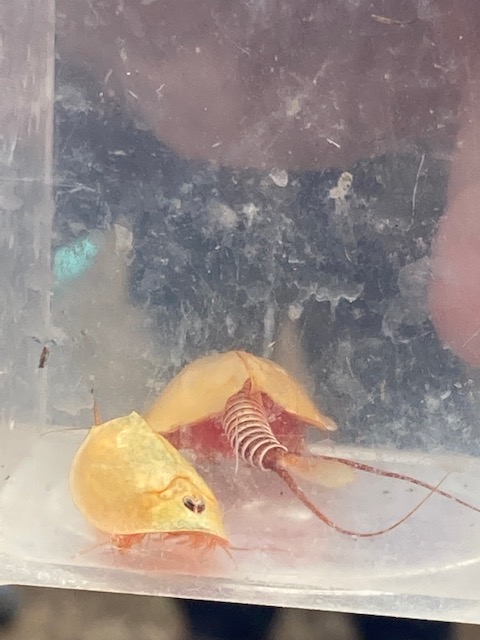
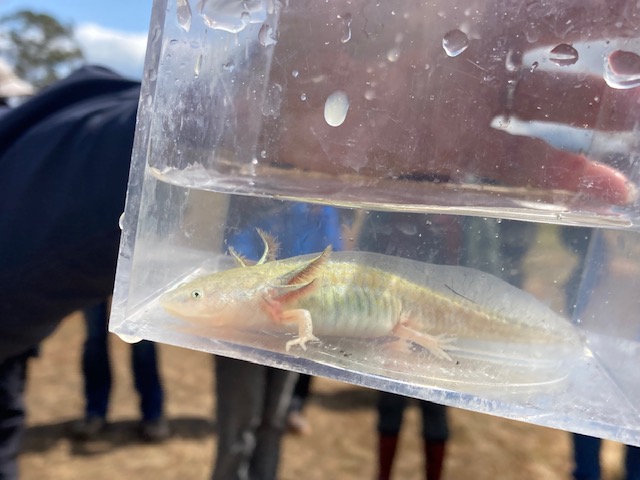
Tadpole Shrimp and Tiger Salamander larva, R.Forest
Fauna:
Valley hardpan vernal pools host highly specialized, endemic, and rare Fauna. These groups and species include invertebrates/macroinvertebrates (several crustacean species, aquatic insects, etc), and amphibians such as the spadefoot toad (Scaphiopus hammondii), and the tiger salamander (Ambystoma californiense).
The valley hardpan vernal pool system hosts an array of macroinvertebrate faunal generalists and specialists, including: crustaceans; copepods; ostracods; cladocera; branchinecta; cyzicus; etc. Further details and tables can be found in the links and references below. The larvae of flying insects are plentiful in valley hardpan vernal pools, and fill an important niche in the ecosystem and in the food web, as top predators as well as prey.
Waterbirds, such as killdeer, greater and lesser yellowlegs, cinnamon teal, great egret, and avocets rely on valley hardpan vernal pools for forage and nesting grounds.

Vernal pool macroinvertebrate taxa are distributed as local populations that are separated by pool geography, but are connected by species migrations, which encourage gene flow and facilitate colonization and repopulation of vacant habitats. Invertebrates, such as crustaceans, rely on passive dispersal of their cysts by wind, water, and by other animals. Valley hardpan vernal pools accumulate invertebrate cyst banks in the soil over thousands of years, and the cysts (eggs) of vernal pool macroinvertebrates can remain viable in the soil for decades. On years with plentiful precipitation vernal pool crustacean populations and cyst banks can multiply quickly.
Due to the monumental loss and degradation of valley hardpan vernal pools across the state from development, agricultural practices, recreation, and non-native species invasions, many vernal pool aquatic organisms are rare, threatened, and endangered. Some of these include the Conservancy fairy shrimp (Branchinecta conservatio); longhorn fairy shrimp (Branchinecta longiantenna); vernal pool tadpole shrimp (Lepidurus packardi); vernal pool fairy shrimp (Branchinecta lynchi); the delta green ground beetle (Elaphrus viridis); the western spadefoot toad (Spea hammondii); and the tiger salamander (Ambystoma californiense).


Coastal Freshwater Seasonal Wetlands, R.Forest
Closing thoughts –
I grew up on a marine terrace amidst northern coastal scrub and seasonal freshwater wet meadows and swales teaming with life. Fueled by northern california’s crisp coastal Mediterranean climate, ocean currents, advection fog, and northwest winds; we enjoyed the dry and wet seasons equally. Even when the wet season was truncated during drought years, the once high water table of our Mesa quickly replenished the saturated meadows, swales, puddles, and ditches. Each one of these wetlands instantly and magically became a vessel of aquatic life. Some of my earliest memories are of gazing into a clear calm roadside ditch on the San Gregorio Fault alive with tiny orange Ostracods, slick black diving beetles, mosquito larvae, and of course the eggs and tadpoles of pacific chorus frogs.
As a young adult field tech I had the opportunity to participate in surveys of high mountain wet meadows in the Sierra Nevada, and experienced a different kind of old California wetland magic amongst the alpine fens and swales and boggy meadows.. counting every dwarf plant species along a tape line; up close and personal with rare mosses, jewel-tinged carnivorous plants, and orchids in the cold early morning dew.. thigh-deep in the warm terraced waters of a fen swimming with fish and frogs, neighboring a willow swale and its nesting Willow flycatchers.
I have never lost the enchantment with the coastal seasonal wet meadows of my childhood amidst the northern coastal scrub, and I have been searching for them up and down the coast ever since. Although some of the swales, ditches, and puddles of that mesa can still emerge on wetter years, they are greatly reduced in size and clarity, and they are now devoid of life.
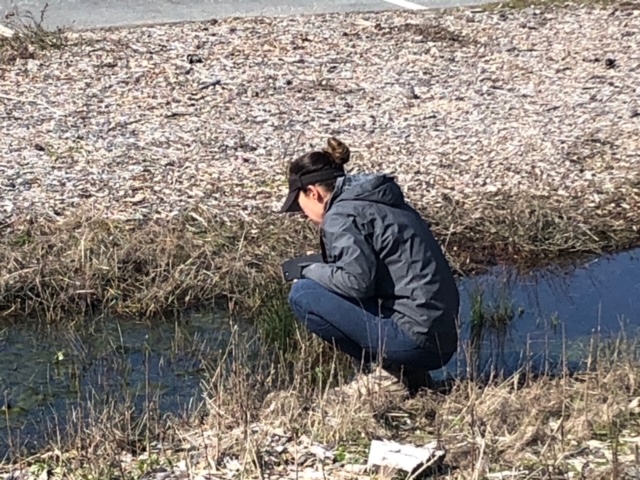
This year was a surprisingly wet bought of stormy weather whiplash after many years of persistent and worsening drought. On my annual informal survey, I have scoured as many of the replenished roadside ditches, cattle ponds, and wet meadows of the central coast as I can. Like the explosion of life carpeting the surrounding hillsides and valleys with lime green foliage and bursting wildflowers, this year’s little seasonal wetlands are vibrant and clear and cold, and beginning to show some signs of aquatic life.
Online Resources:
Coastal Seasonal Wet Meadows and Swales:
UC Santa Cruz Terrace Lands seasonal wetlands at Younger Lagoon Preserve
UC Santa Barbara NCOS vernal pool restoration
Half Moon Bay bluffs Wavecrest property wetland restoration proposal
Mount Burdell Preserve, Novato – Hidden Lake seasonal wetland
Sonoma Mountain Vernal Pools Ecological Preserve – Sonoma Land Trust
Backdune Seasonal Wetlands and Dune Swales:
CSU Monterey Bay Fort Ord vernal pool restoration
Lanphere Dunes and wetlands – Humboldt Bay NWR
Tomales Bay Dunes and seasonal dune wetlands
Valley Hardpan Vernal Pools:
Jepson Prairie Preserve vernal pools – Solano Land Trust
Rancho Seco Howard Ranch Trail vernal pools
Southern Coastal Mesa Hardpan Vernal Pools:
Vernal pools in the chaparral – San Diego County
San Diego County vernal pools restoration
Santa Rosa Plateau vernal pools – Riverside County
Other Subjects:
Slideshow – Seasonal Variation of Macroinvertebrates in a California Temporary Wetland
UC Davis DNA Resources to Monitor and Manage Vernal Pool Species in California
Slides – Temporary Wetland Bioassessment
References:
Barbour, Michael, T. Keeler-Wolf, and A Schoenherr. 2007. Terrestrial Vegetation of California. Berkeley: University of California Press.
Bartoldi, G, and Walter C. Swain. 1995. “National Water Summary-California Wetland Resources: State Summaries.” U.S. Geological Survey Water-Supply Paper 2425: 127-134
Bauder, Ellen T., Andrew J. Bohonak, et al. 2009. “A Draft Regional Guidebook for Applying the Hydrogeomorphic Approach to Assessing Wetland Functions of Vernal Pool Depressional Wetlands in Southern California.” San Diego State University
California Tiger Salamander and California Fairy Shrimp Aquatic Sampling Survey Report – at Fort Ord. 2007. Shaw Environmental, Inc.; Denise Duffy & Associates, Inc.
Elam, Diane R., Todd Keeler-Wolf, et al. 1998. State of California Department of Fish and Game California Vernal Pool Assessment Preliminary Report. Natural Diversity Database
Keeley, Jon E. 1996. “Characterization and Global Distribution of Vernal Pools.” Ecology, Conservation, and Management of Vernal Pool Ecosystems – Proceedings from a 1996 Conference. California Native Plant Society, Sacramento, CA: 1-14
Lunde, Kevin B., and Vincent H. Resh. 2012. “Development and validation of a macroinvertebrate index of biotic integrity (IBI) for assessing urban impacts to Northern California freshwater wetlands.” Environmental Monitoring Assessment 184: 3653–3674 DOI 10.1007/s10661-011-2214-4
Mooney, Harold and Erika Zavaleta. 2016. Ecosystems of California. Oakland: University of California Press.
NatureServe. International Terrestrial Ecological System: Mediterranean California Coastal Interdunal Wetland. Element Code: CES206.951. https://explorer.natureserve.org/Taxon/ELEMENT_GLOBAL.2.722730/Mediterranean_California_Coastal_Interdunal_Wetland
O’brien, Sean M. 2021. “Aquatic invertebrate community differences in constructed and natural California vernal pools.” Thesis; California State University Sacramento.
Peterson, Michael G. , Kevin B. Lunde, et al. 2017. “Seasonal progression of aquatic organisms in a temporary wetland in northern California.” Western North American Naturalist 77(2): 176–188
Reed, L.K., M. Hatch, et al. 2011. “Reference site characterization and restoration goals for northern coastal scrub and seasonal freshwater wetlands at Younger Lagoon Reserve, Santa Cruz, California.” Report for the California Coastal Commission
Simovich, Marie A. 1996. “Crustacean Biodiversity and Endemism in California’s
Ephemeral Wetlands.” Ecology, Conservation, and Management of Vernal Pool Ecosystems – Proceedings from a 1996 Conference. California Native Plant Society, Sacramento, CA: 107-118
Stein, Eric D., Kevin Lunde, et al. 2017. “Assessment of the condition of San Francisco Bay Area Depressional Wetlands.” SCCWRP Technical Report 940
US Army Corps of Engineers, and Jones and Stokes Associates. 1992. Flora and Fauna Baseline Study of Fort Ord, California
US Fish and Wildlife Service, Department of the Interior. 2003. “Endangered and Threatened Wildlife and Plants; Final Designation of Critical Habitat for Four Vernal Pool Crustaceans and Eleven Vernal Pool Plants in California and Southern Oregon.” Federal Register Rules and Regulations Vol. 68, No. 151: 46684-46866
Witham, Carol and Kate Mawdsley, editors. 2012. Jepson Prairie Preserve Handbook, 3rd Edition. Fairfield: Solano Land Trust.
Witham, Carol W., Jennifer Buck-Diaz, & Robert F. Holland. 2018. “Vernal pools: biodiversity, biogeography, threats, and conservation.” Fremontia 46(2): 36-41


Discover more from Cal Geographic
Subscribe to get the latest posts sent to your email.
