
Serpentinite Habitats in California
Serpentinite rock forms the landscapes and soils that support some of California’s most rare and endemic species and habitats. A product of our young and rugged tectonic landscape, serpentinite defines and punctuates the accreted wilderness of the Klamath Mountains, the foothills of the Sierra-Nevada, and the emergent transform slopes and valleys of the Coast Range.
Serpentinite is a prominent member of the geologic family of ultramafic rocks and soils, which deliver a harsh and restrictive medium for plants to tolerate. Low in the essential nutrients plants need to grow and survive, and high in toxins suppressing growth, serpentinite soils encourage specialized adaptations, and the evolution of rare and endemic serpentinite species and habitats in California. The geology and geomorphology of serpentinite is reviewed in more detail in our Landforms post, Serpentinite in California.

As we know, species ranges and habitat mosaics do not fit neatly within geographic or ecological designations, and there are no natural communities in California that are wholly serpentine obligate assemblages. While systems are often labeled as serpentine habitats (“serpentine grassland,” etc), a more realistic way to review serpentine systems are as habitats that also can tolerate or occur on serpentine.
For instance, chaparral as a broad habitat type occurs on many soils in California in addition to ultramafic substrates. However, under the umbrella designation of chaparral habitat, there are numerous chaparral vegetation community types/associations, some of which flourish on serpentinite (e.g. Arctostaphylos glauca-Quercus durata Association). However, many of the species found within these associations are not serpentinite obligates and grow in other substrates as well.
This biogeographic review of serpentinite habitats will include barrens, grasslands, chaparral, woodlands, and wetlands. Each of these ecological topics deserves a lifetime, or at least an entire career-worth of dedicated research. This analysis opens the door, offering a geographic perspective and a starting point for further investigation.
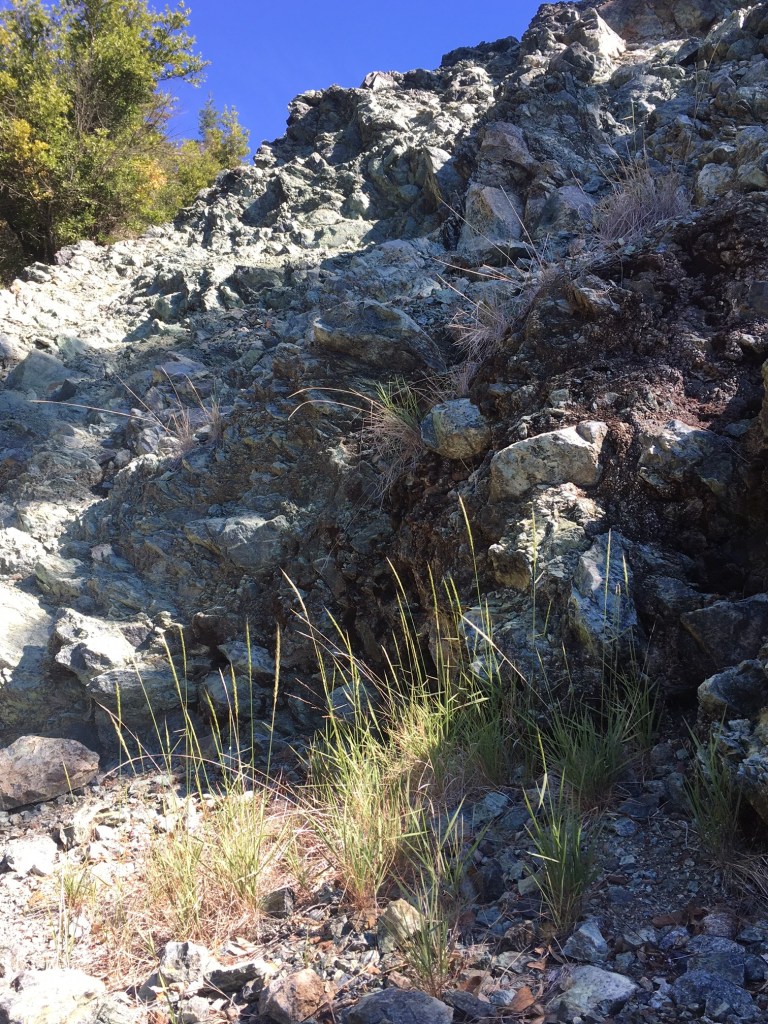

Serpentine Syndrome Adaptations
In California, there are over 200 serpentinite-endemic plant taxa. In response to the unique and limiting geochemical conditions of serpentinite and ultramafic substrates, plant species have developed coping strategies, which has led to widespread speciation and endemism within the serpentinite landscapes and habitats of California.
In general, serpentine syndrome produces sparse and stunted vegetative physiognomy. Within serpentinite communities, common characteristic adaptations include: dwarfism; reduced cover; a lower abundance of certain species; a reduction in species richness; sparse distribution of species within a range; and endemism.
In order to survive and thrive in an ultramafic environment, serpentinite-adapted plants have developed coping strategies to tolerate the geochemistry of the soils. These strategies range from selective uptake and the ability to mobilize nutrients; the ability to exclude metals and toxins, or to accumulate them in a non-toxic form; and the ability to tolerate water stress.

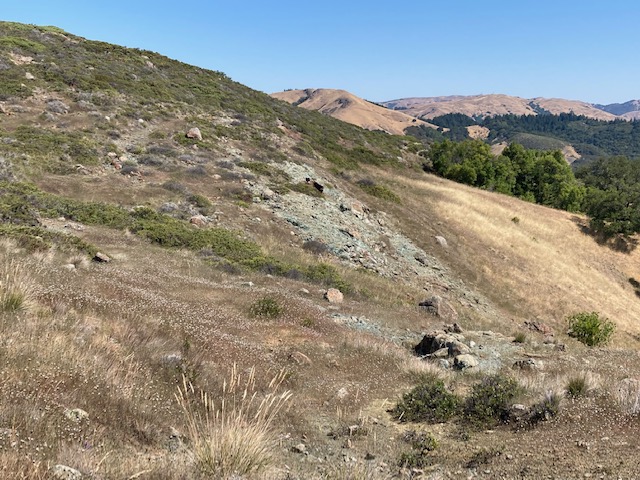
Barrens on Serpentinite
Perhaps the most striking, stunted, and species-limited serpentinite environment are serpentinite barrens. Most serpentinite barrens are just that: barren, sparse, rocky and dry habitats that frequently occur on hot south facing slopes of the Coast Ranges and Klamath Mountains. Topographically, serpentinite barrens present a landscape that resembles a lifeless gravel patch; but on closer investigation a specialized ecosystem is revealed.
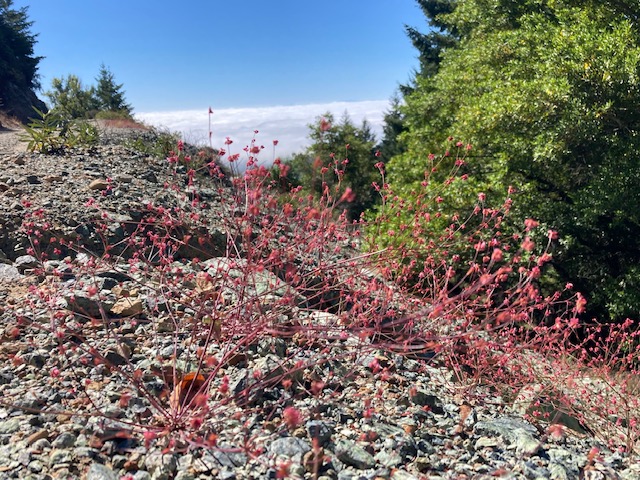
Formally described as containing no woody species, but a very sparse herbaceous cover of xeromorphic annuals and perennials, serpentinite barrens develop very thin, gravelly soils with the highest concentrations of magnesium and heavy metals. In addition, the thin soils and gravelly particle size of the barrens’ substrate provides a porous medium, with very low water retention. Due to these selective pressures a sparse flora dominated by rare and endemic short-stature herbaceous species has developed.
In the Klamath Mountains, serpentinite barrens host the highest percentage of specialized narrow endemics out of all ultramafic ecosystems. This is due to the small patch size and fragmentation/isolation of these habitats, as well as the extreme geochemical and physical conditions of this harsh environment.

Grasslands on Serpentinite
While native grasslands make up only a small percentage of the plant communities found on serpentinite soils in California, they are a rare and integral thread in the fragile web of California’s ecosystem mosaic.
Serpentinite grasslands are diverse, and can develop in shallow-rocky, to deep-fertile serpentinite soils. They are most prominently dispersed throughout the Coast Ranges, and along the southwestern low elevation slopes of the Sierra-Nevada. In the northern Coast Range serpentinite grasslands are found in patches inhabiting fertile soils of gentle slopes and valley bottoms, amongst chaparral and woodland ecosystems. The highest percentage of grasslands on serpentinite in California, are found in the San Francisco Bay Area on steep slopes and ridgelines in shallow-rocky soils.
Variations in slope, aspect, soil depth, and moisture content promote differences in species composition within the ranges of serpentinite grasslands. And within a habitat patch serpentinite grassland species segregate mainly based on soil depth, moisture availability, and nitrogen content.
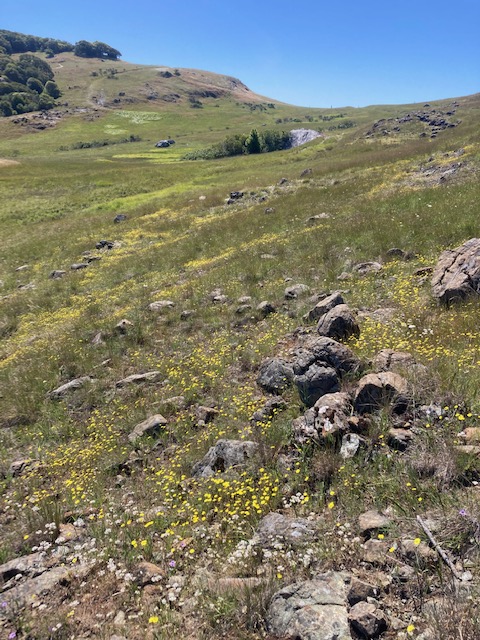


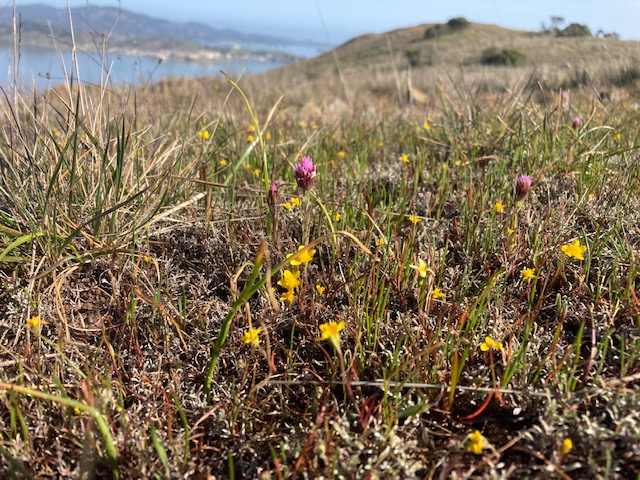

A higher abundance of native grass species are found in serpentinite soils than other soils in California. And within serpentinite soil types shallow-rocky serpentinite soils host more native and endemic grassland plant species than the deep-fertile serpentinite soils. The deeper soils also host a higher percentage of exotic and invasive species accustomed to grasslands.
Serpentinite grasslands are actually better described as meadows or prairies, and are often dominated not by grasses, but by forbs (herbaceous flowering plants such as wildflowers), which are not serpentinite-dependent species. In the San Francisco Bay Area the dominant species of serpentinite grasslands are perennial bunch grasses associated with annual forbs. The San Francisco Bay Area serpentinite grasslands also host at least 20 rare or endangered plants and insect species.
On Ring Mountain Open Space Preserve in Marin County, all grassland alliances have been surveyed and mapped, with an eye on serpentinite communities and the rare and endemic species this peninsula is known for. Fine scale grassland mapping has revealed several prominent species alliances and their associations. These patches within the mosaic of thin-soiled rocky slopes and undulating wetland bottom-lands, are delineated along the edaphic and hydrologic dividing lines of the landscape.

Chaparral on Serpentinite
Inhabiting the steep slopes and rugged terrain of all of California’s mountain ranges, as well as distinct lower elevation coastal topographies, chaparral is the State’s most widespread and emblematic habitat type. The geographic range of serpentinite geology in California precisely falls within the range of chaparral. Link here for an in-depth review of the biogeography of California’s chaparral mosaic
Chaparral habitats and alliances in California are extremely diverse, and most are found in small and often isolated patches. While manzanitas, and other woody dominants of the chaparral may be somewhat young taxa evolutionarily, the structural adaptations of woody, evergreen, schlerophylous shrubs are ancient shared physical traits, developed in response to arid environments and poor substrates.
Evolving in step with California’s Mediterranean climate, varied and depauperate slope soils, soil moisture levels, and cyclic wildfire regimes, a multitude of woody shrub species (namely Arctostaphylos spp have evolved and speciated within chaparral communities. Ultramafic and serpentinite soils figure prominently within this process.
Based on biogeographic and bioclimatic studies, five distinct chaparral communities in California have been classified as ultramafic/serpentinite-dependent. All five types are associations of the Quercus durata alliance. Quercus durata, (California Scrub Oak, Leather Oak), is a serpentinite obligate species, and endemic to California.

The five ultramafic chaparral associations include: Ceanothus jepsonii-Quercus durata; Ceanothus albiflora-Quercus durata; Arctostaphylos glauca-Quercus durata; Arctostaphylos viscidaes-Quercus durata; and Hesperoyucca whipplei-Quercus durata associations.
Natural wildfire cycles are a driver of diversity and speciation in chaparral systems broadly. Due to low soil nutrient levels there is a lower amount of detritus and biomass accumulation within serpentinite chaparral systems, resulting in reduced frequency and strength of wildfire on serpentinite chaparral landscapes. Thus, wildfire does not have as big an influence on serpentinite chaparral evolution, and one result is serpentinite chaparral plant species are rarely obligate fire germinators.
Forests/Woodlands on Serpentinite
There are a variety of woodland ecosystems on serpentinite substrates in California. As with the herbaceous and woody shrub species in ultramafic environments, tree species must contend with, and have adapted to, the biogeochemical restrictions of serpentinite soils.
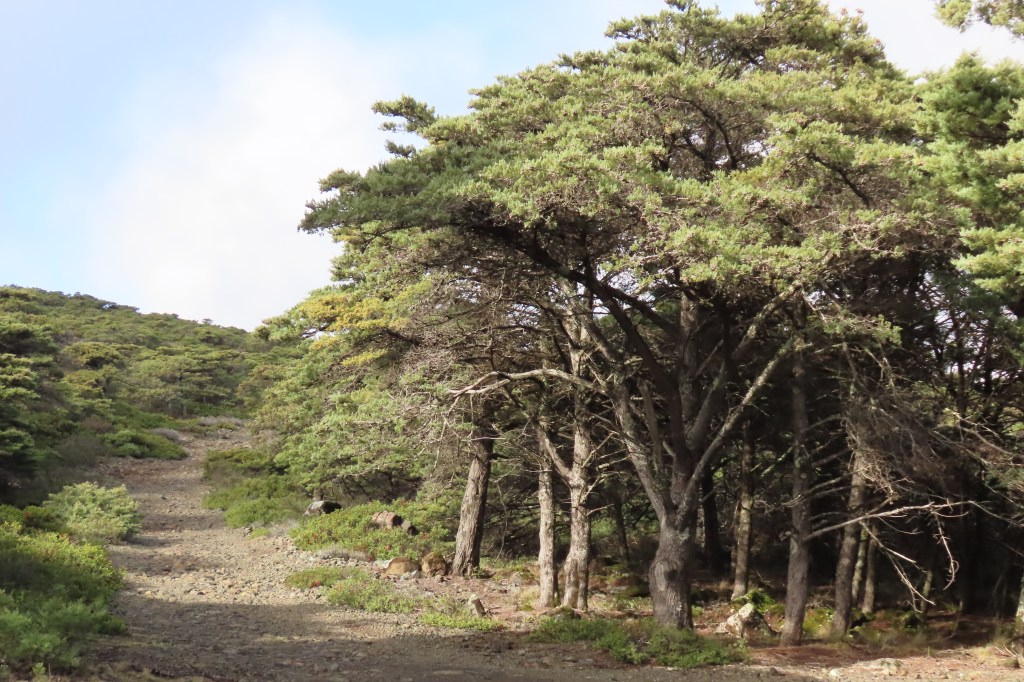
Most woodlands on serpentinite can be described as open stands of thin canopy cover. Tree species on serpentinite often display stunted growth, and have the ability to develop more robustly on non-ultramafic soils. Some tree species are serpentinite/ultramafic obligates, such as the Sargent cypress, while most other tree species found on serpentinite terrain also grow in wide-ranging soil types.
Serpentinite woodlands are usually dominated by an understory of woody shrubs and patchy herbaceous grassland cover, amongst a rocky or gravelly landscape. Woodlands on serpentinite often occupy dry, rugged slopes of California’s ultramafic alpine terrain.

Sargent Cypress – Hesperocyparis sargentii
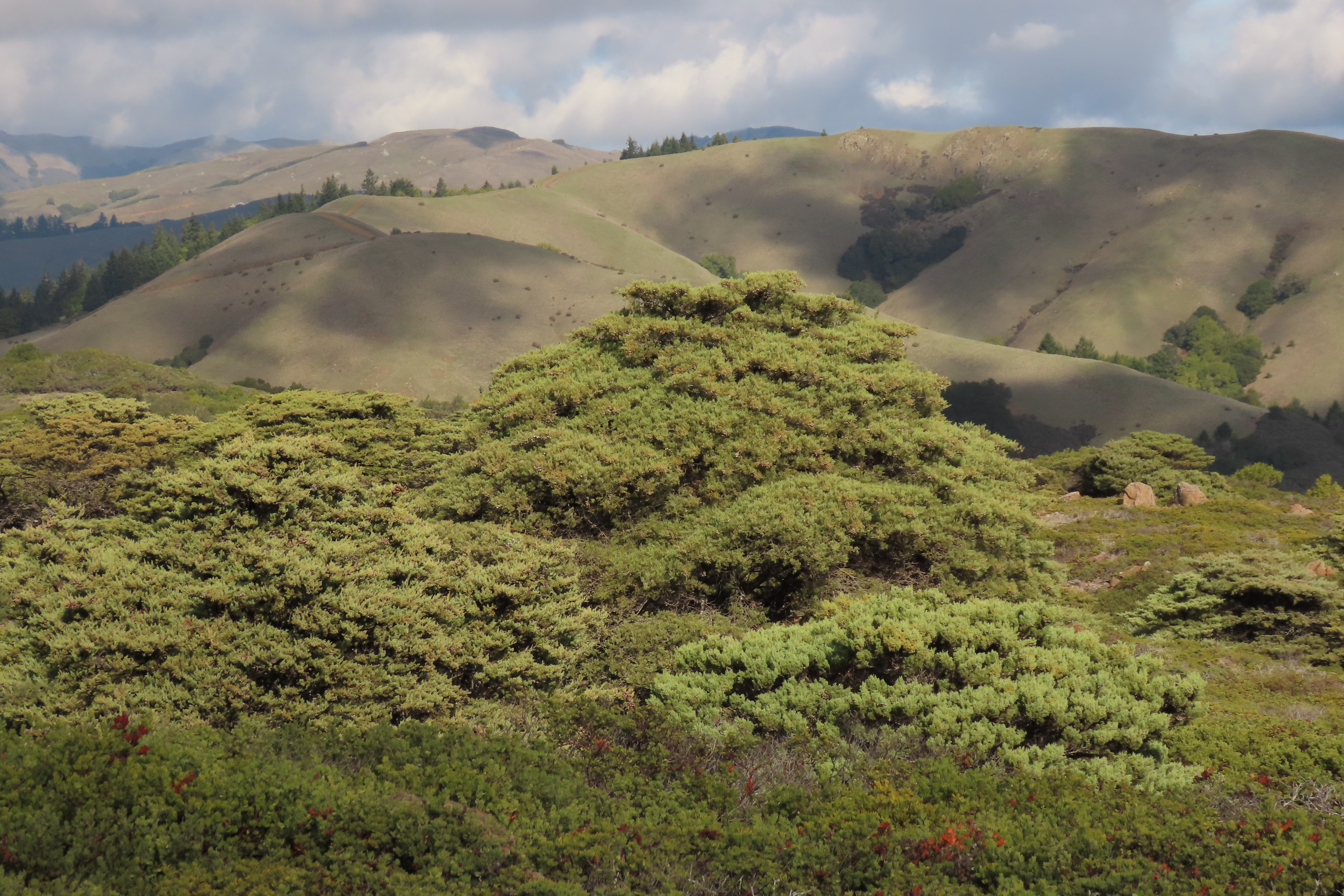
The Sargent cypress (Hesperocyparis sargentii) is one of the few, if not the only, endemic serpentinite tree species in California. In partnership with the California endemic serpentinite obligate chaparral shrub species, Quercus durata, Hesperocyparis sargentii forms a mixed chaparral/woodland habitat, distributed patchily throughout the Coast Ranges.
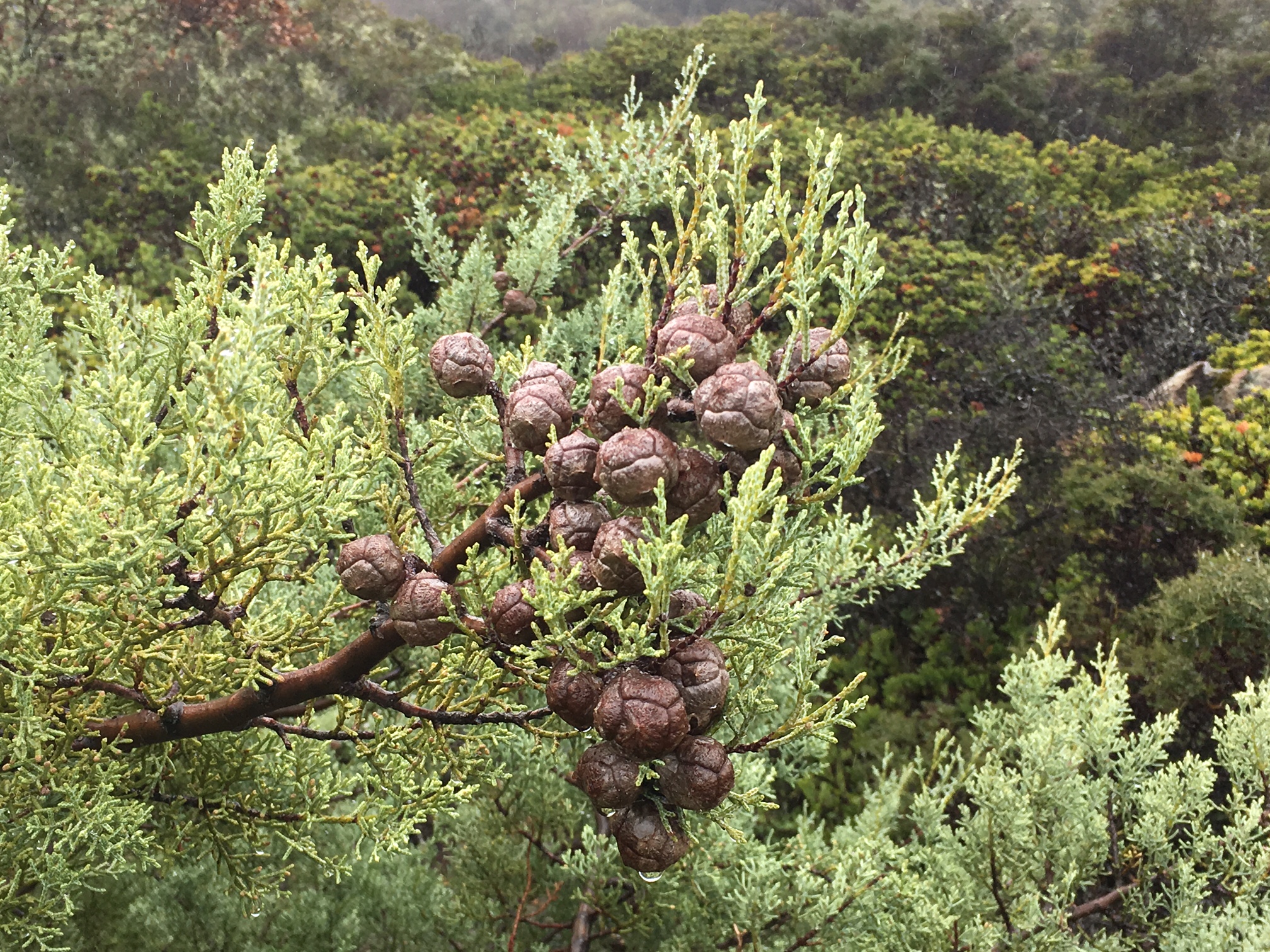
Hesperocyparis sargentii are small to mid-sized trees in the Cupressaceae family, with the signature knotted cones, tight, waxy, dark green foliage, and twisted furrowed bark of a cypress. They can grow 30-50 feet tall on average, and are found at mid elevations of the Coast Ranges from about 600-3000 feet.

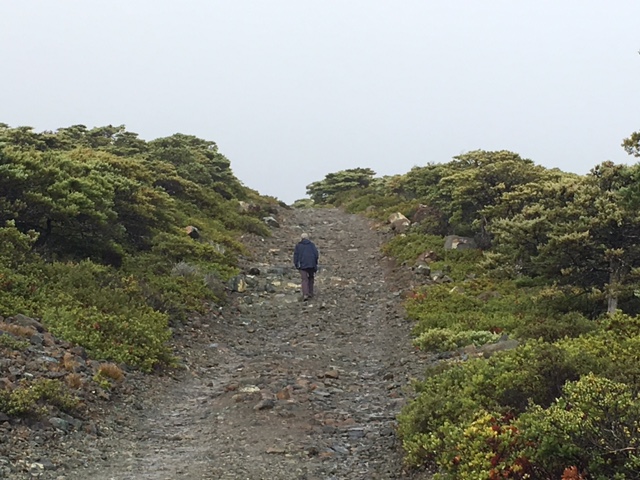
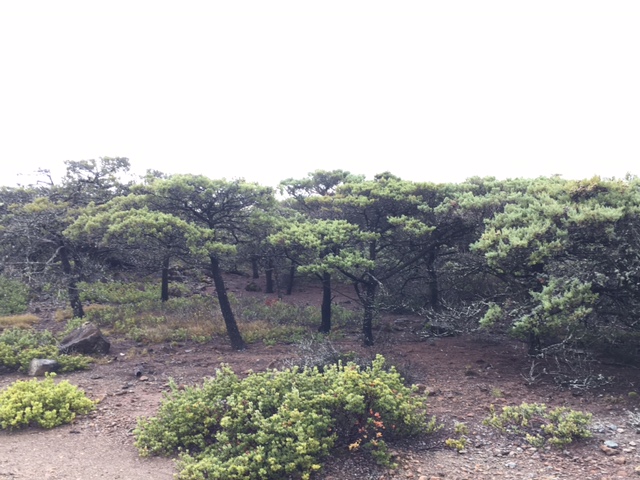
Famously, Hesperocyparis sargentii form picturesque pygmy forests within the chaparral on heavily serpentinized ridge tops and slopes in the Coast Range, maintaining stunted heights of only eight to 12 feet on average. These striking landscapes present a quintessential serpentine picture of balanced and open community structure, symmetry, and flow within the expansive geomorphic mosaic.
Hesperocyparis sargentii is dependent on cyclic wildfires for seed germination. The cones of Hesperocyparis sargentii only open when burned, and seeds disperse locally to surrounding substrate, requiring bare mineral earth and full sun to germinate. Seedlings are highly susceptible to failure if they rest on moist, shady, or duff-laden substrates, which leave them vulnerable to fungus. When seeds do germinate following a fire event, young trees can flourish and form tight clustered groves. Eventually a mature, open scrubby Sargent cypress forest forms amongst the chaparral landscape, and is dependent on a natural wildfire regime to persist.
Grey Pine – Pinus sabiniana
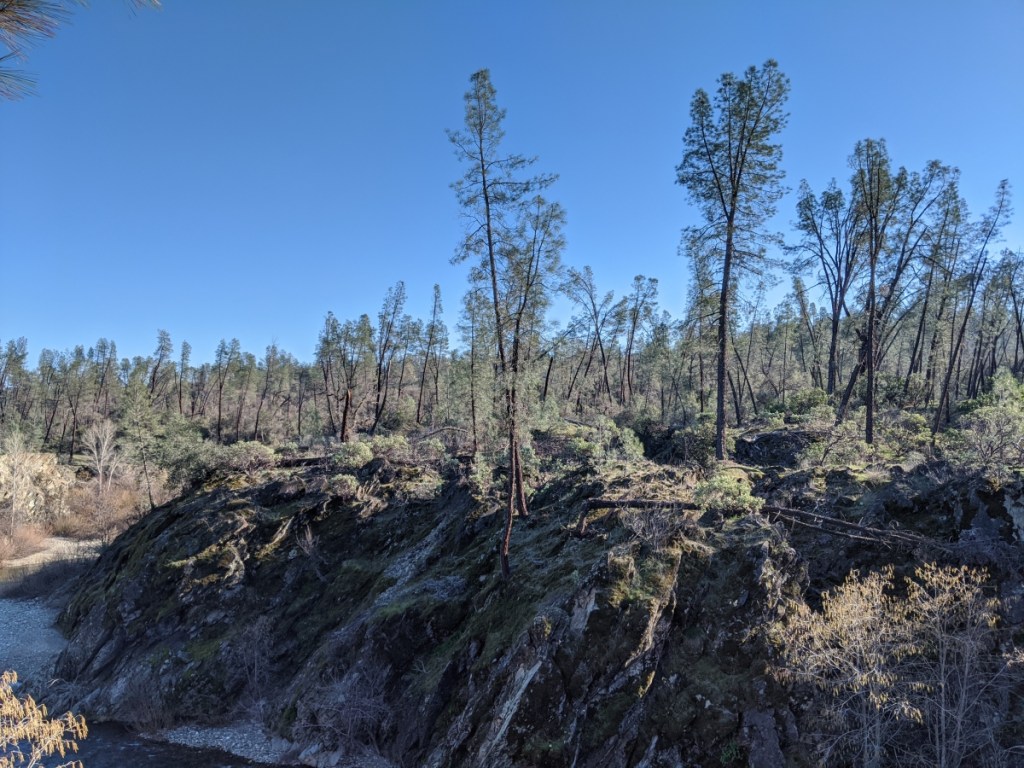
Pinus sabiniana is endemic to California and is found at low to mid elevations throughout all of California’s mountain ranges, including sky islands within the Mojave Desert. With wispy silver needles, and lanky stature, the Grey pine is a hearty, highly drought- adapted California native, found on dry interior slopes, specializing in thin, rocky substrates, and serpentinite soils in particular.
Together with other interior tree species, (most often the Blue Oak, Quercus douglasii, another drought adapted California endemic), Pinus sabiniana commonly forms an open oak-pine woodland alliance amongst chaparral. The Grey Pine can tolerate as little as 10 inches of precipitation annually, and thrives on serpentinite landscapes by regulating uptake of nutrients and toxins from the soil.
In order to survive the hot, dry slopes of California’s interior, other adaptions include elongated, silvery needles that evade and reflect sunlight; flammable bark, needles, and cones that encourage the spread of natural wildfire to clean off lower growth and dead branches; and cones that are dependent on wildfire to open and disperse seeds to germinate atop bare mineral soil.
Northern Foxtail Pine – Pinus balfouriana ssp. balfouriana
The Klamath Mountains are formed by a complex of accreted terranes, which are distinct exotic geologic units varying in age and chemistry, and high in serpentinite. The geomorphic variables of the age of the terranes, elevations, and moisture gradient from west to east, have fostered a suite of unique geologic environments, specialized ecosystems, and rare and endemic species.
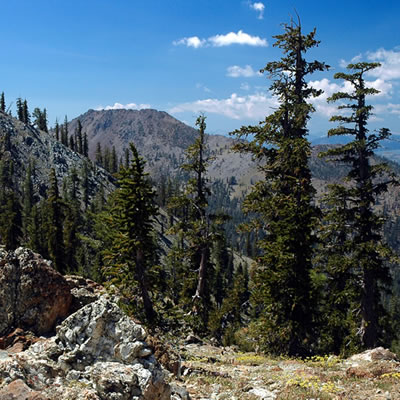
Amongst the rugged alpine environment of the Klamath Mountains, many specialized conifer species have adapted to the serpentinite substrates and topography. One rarity in particular is the Northern foxtail pine, (Pinus balfouriana ssp. Balfouriana) endemic to the Klamath Mountains, and residing at high elevation serpentinite landscapes.
In order to tolerate the frigid and wind-swept environment, the Northern foxtail pine is short to mid-stature in height (30-40 feet average at maturity), develops a wide sturdy trunk; and its needles form in dense clusters directly off the stock of the branches. Pinus balfouriana alpine woodlands form open, rocky, bare soil understories, to lightly vegetated with herbaceous cover and patchy grasses. At the lower elevations of the Northern foxtail pine’s range, woody shrub and herbaceous understory cover increases.
The Foxtail pine is a paleoendemic taxa, once widespread over 10 million years ago, that has been reduced to two tiny disparate alpine ranges over 300 miles apart in the Klamath and Sierra-Nevada mountains. The shrinking of its range over the millennia separated the genetic population, resulting in the evolution of the two remnant subspecies: Pinus balfouriana ssp. balfouriana in the Klamaths, and Pinus balfouriana ssp. austrina in the Sierra Nevada.

Wetlands on Serpentinite
As with all things seasonal-freshwater-wetland in California, wetlands on serpentinite are scantily studied and virtually unrecognized. One can find sparse information concerning serpentinite wetland geology and pedology with concerted effort. Botanical lists of California’s serpentine wetland plant species can sometimes be pieced together per site, with time. But there appears to be a total lack of studies or information concerning aquatic fauna and invertebrates of serpentine wetlands in particular.
To begin with, there are many types of wetlands on serpentinite across California, both seasonal and perennial, within diverse environments. What they have in common is geology. Serpentinite rock (parent material) erodes, fractures, and weathers readily. Well-weathered serpentinite breaks down to the size of clay particles, and as serpentinite soils increase in depth, there is an increase in clay particles.
Well-weathered and well-developed serpentinite soils form smectite clay minerals, which swell when hydrated, and tend to absorb and hold large amounts of water. Serpentinite clay particles and soils can also be less developed, and contain more coarse grain fragments, producing well-drained wetland soils.
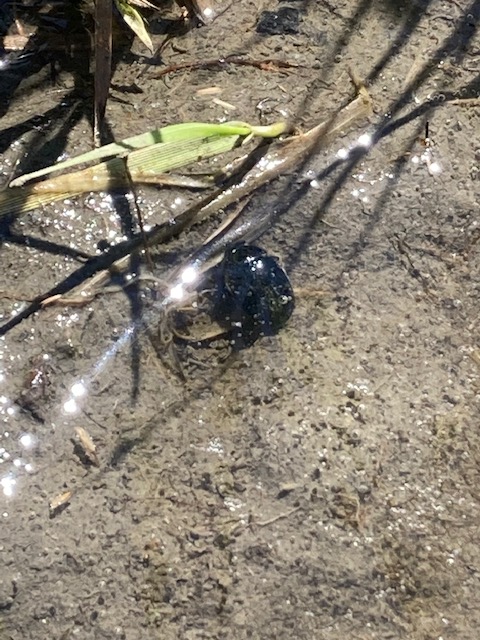
On poorly drained serpentinite landscapes, where fractured and weathered rock retains water and has formed deeper soils, seeps and wet meadows can emerge, encouraging the development of hydrophytic plant communities. The deposition of organic plant material into the wetland over time accelerates organic soil formation within the serpentinite wetland as well.
Wetlands on serpentinite can appear as small sags or cuts on the landscape, delineated by the dark green foliage of juncus species; as bright green patches of flowing carex amongst a dry grassland; as ponding with emergent vegetation at the base of serpentinite landslide scars; and as seasonal springs gurgling from the side of a serpentinite slope or scarp.
Serpentine wetlands in California often host unique and rare plant assemblages, owing to the ultramafic-influenced soil conditions and hydrology.
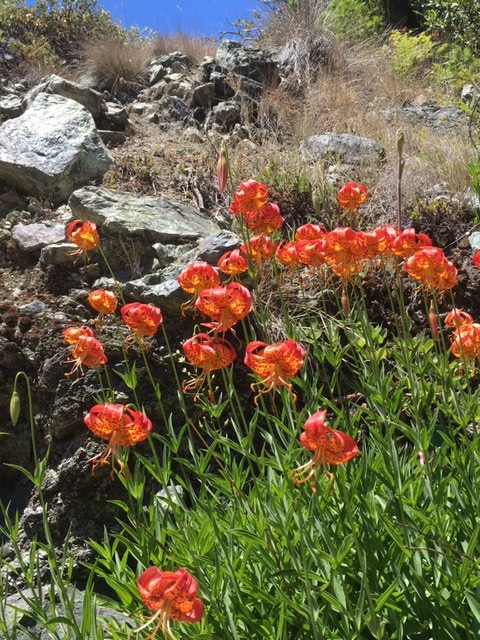
Serpentinite Spring – Mount Tamalpais
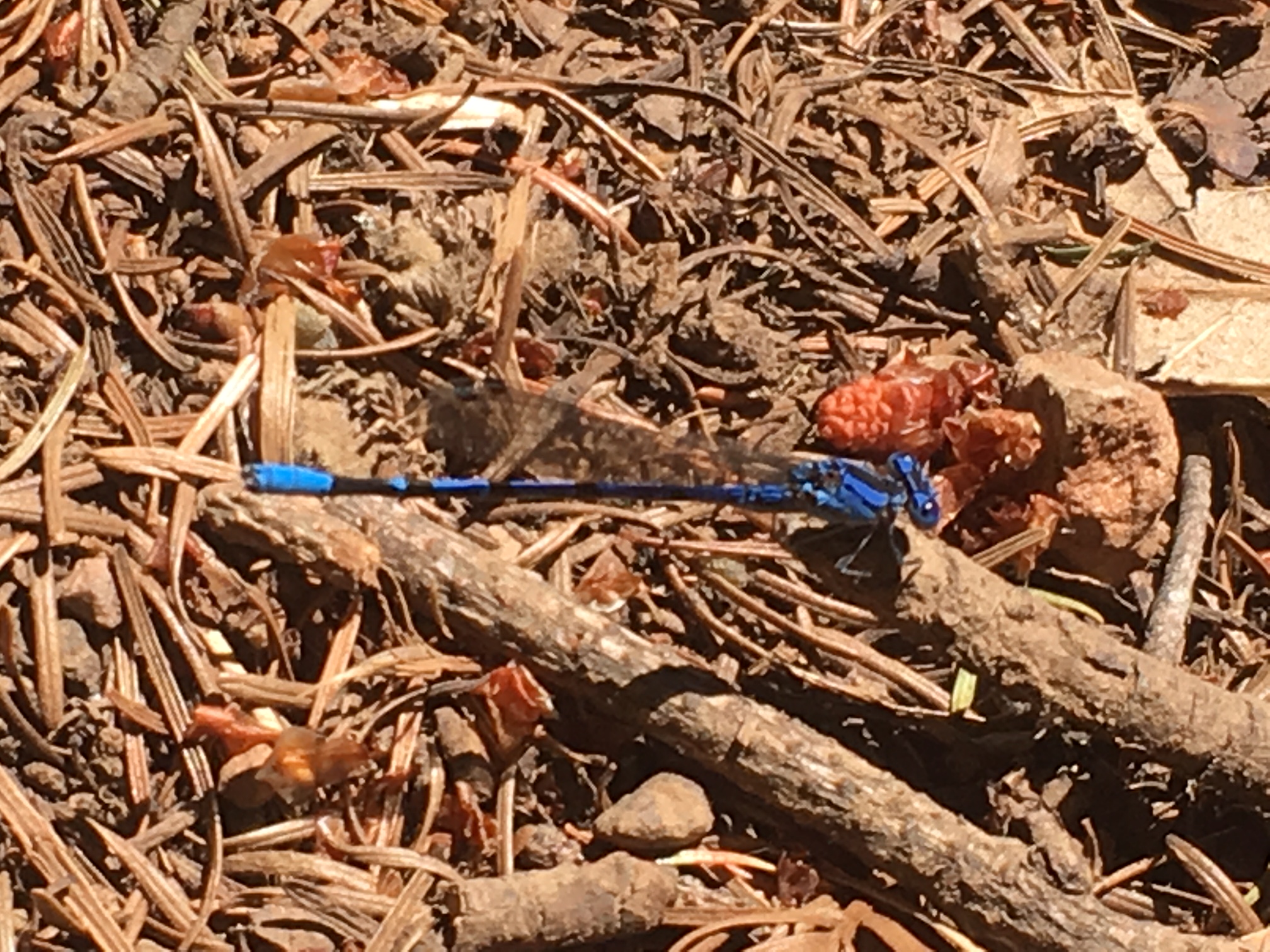
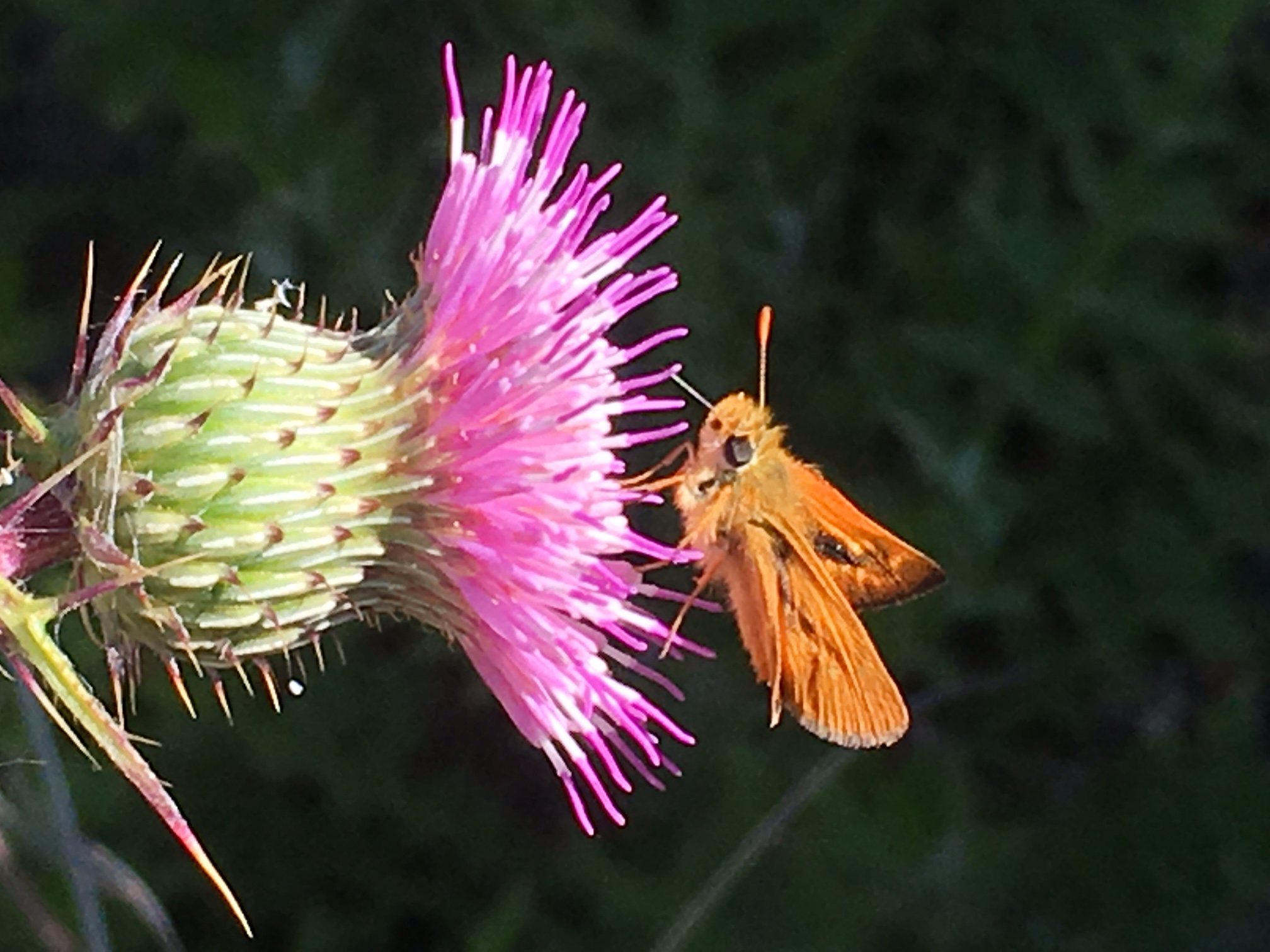
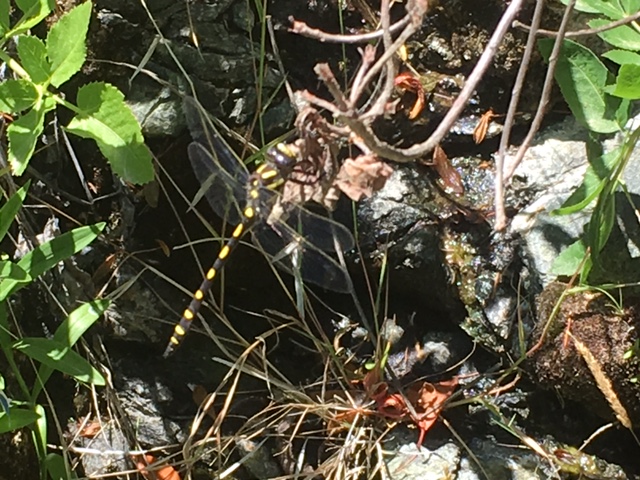
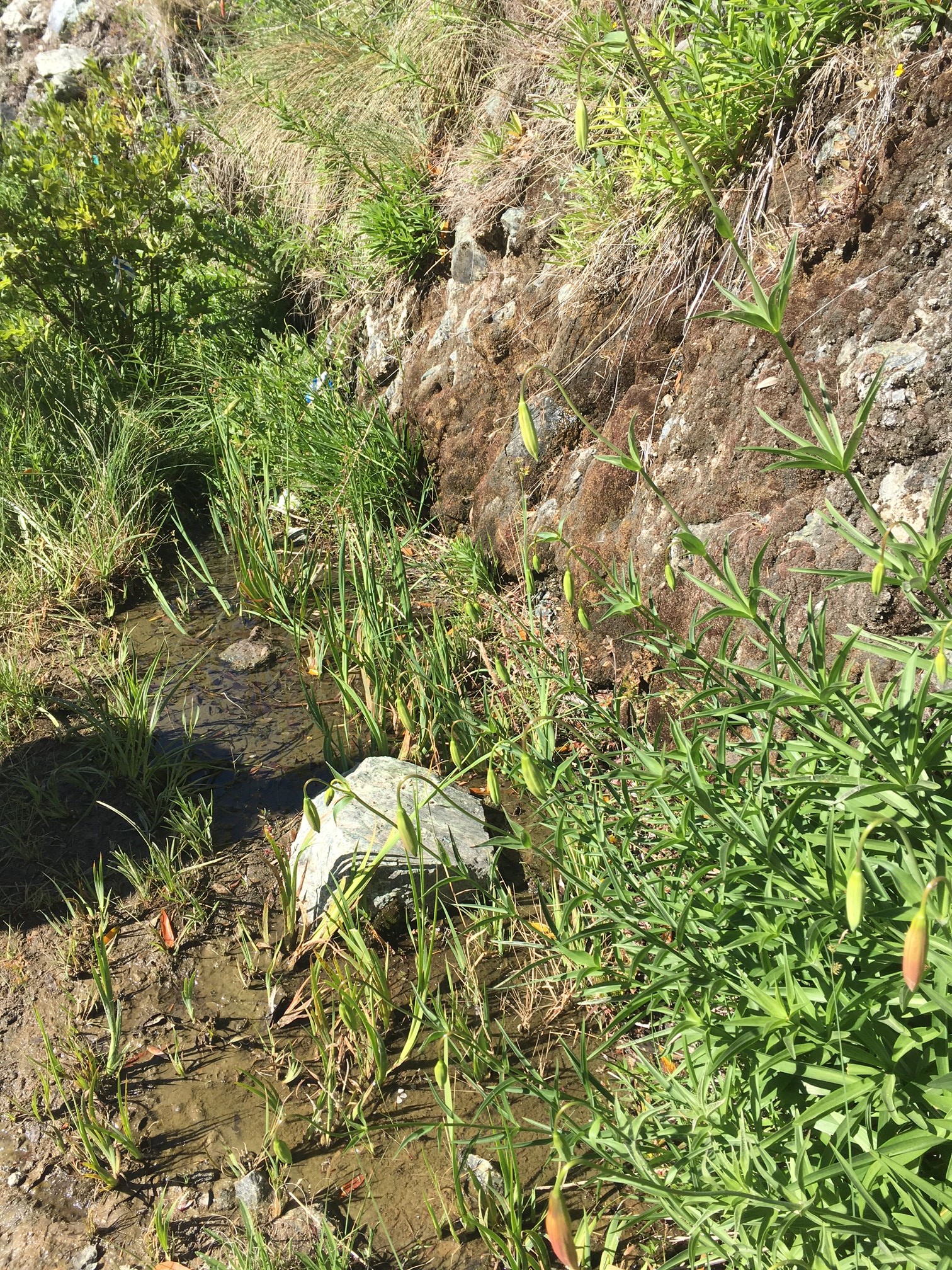
Typical of small, low elevation serpentinite wetlands throughout the Coast Ranges, each spring a verdant and colorful oasis of plant, insect, and bird life emerges on the steep, hot, south facing serpentinite slopes of Mount Tamalpais in the central Coast Range. Subject to consistent drought conditions, seasonal temperatures regularly in the 90’s to over 100 degrees, and actively eroding serpentinite slopes from above, an unnamed spring along an old stagecoach road cut seasonally produces cool flowing waters, and with it an explosion life.


R. Forest
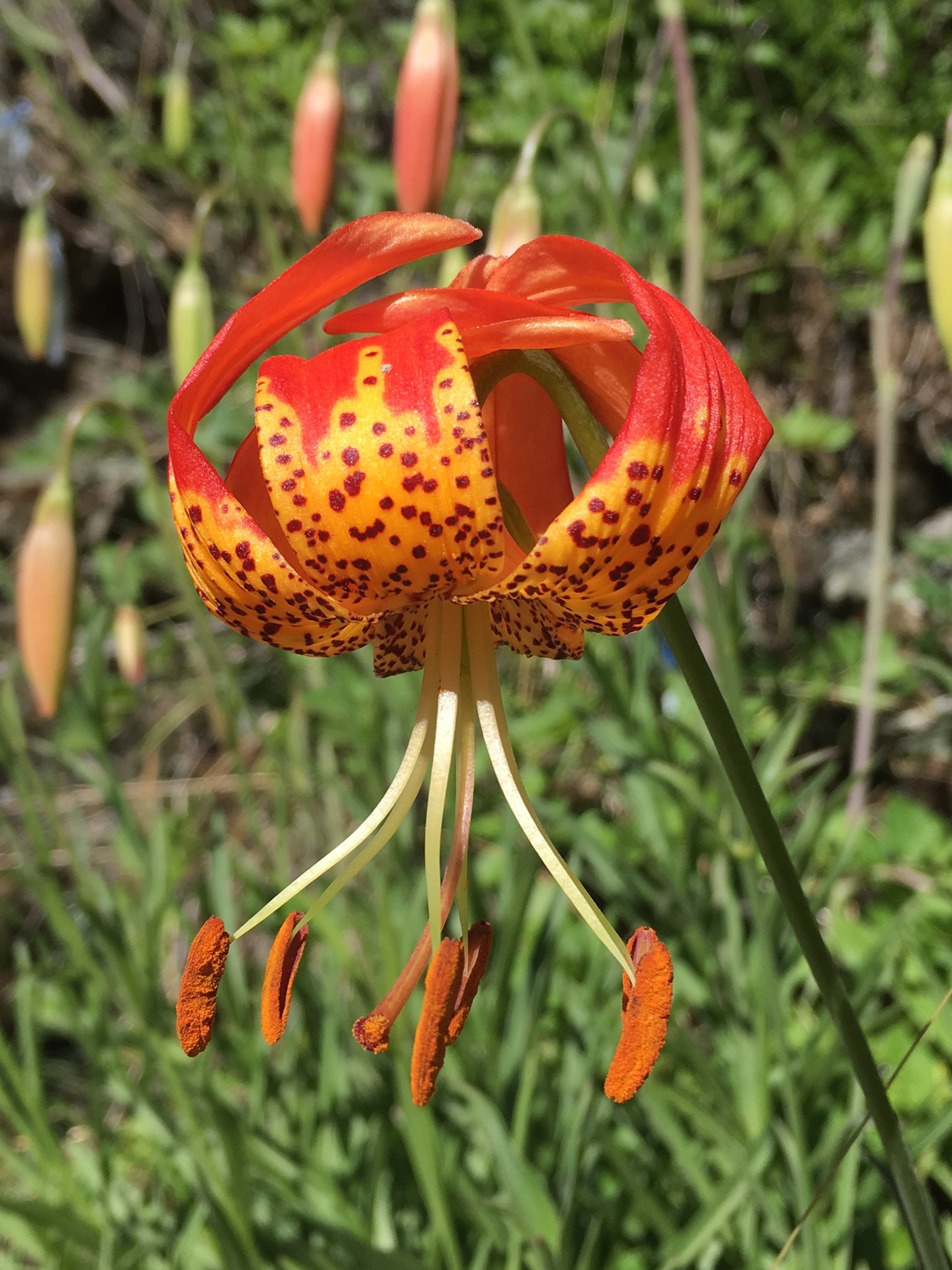
With the backdrop of a wall of shining aqua blue-green serpentinite rock face, California Leopard lilies (Lilium pardalinum pardalinum) emerge from the wetland margins each spring in hot-orange and saffron brilliance. The wetland buzzes with pollinators, Swallowtails, Umber skippers, and Allen’s hummingbirds.

R. Forest
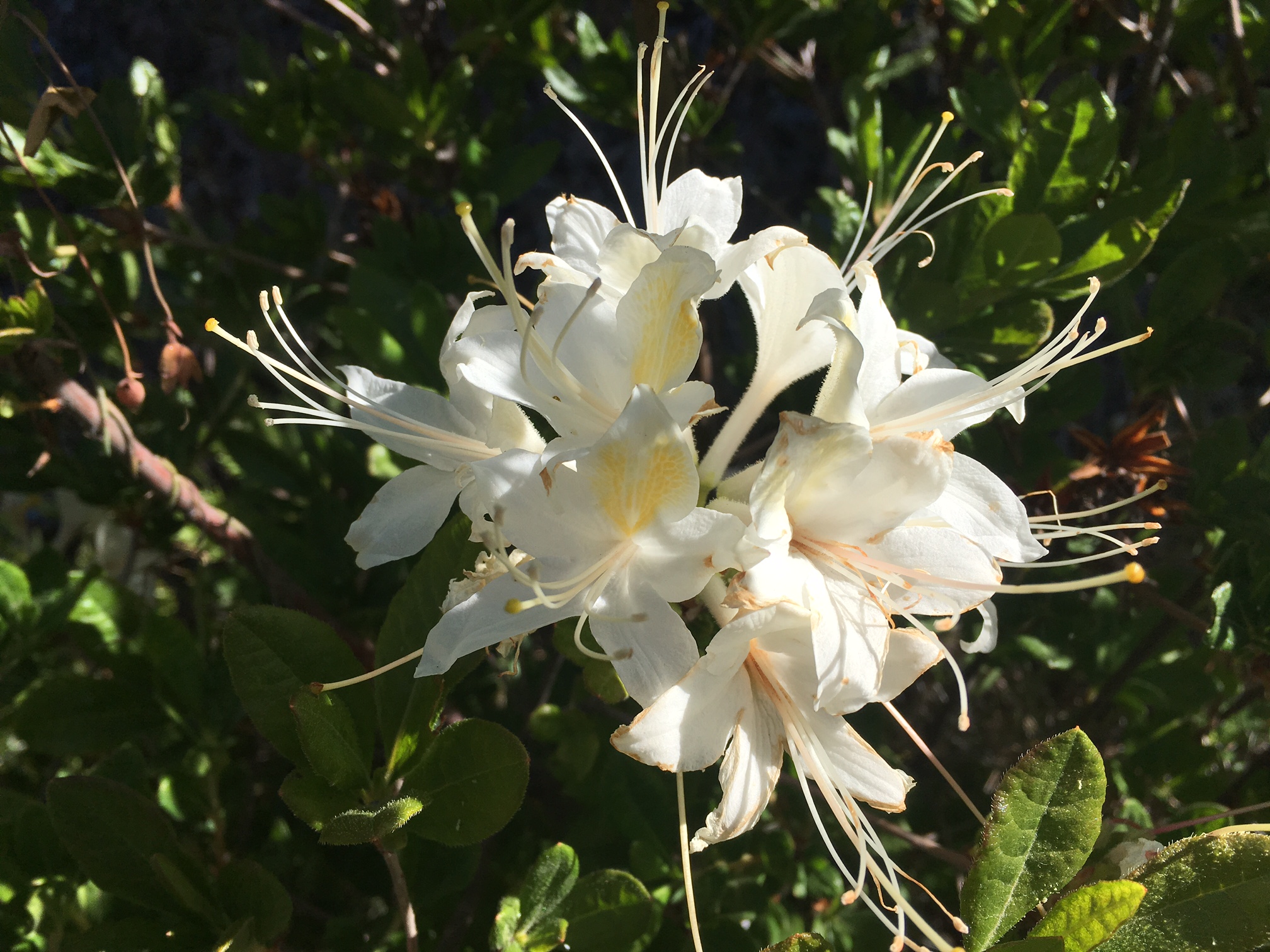
Amphibians, reptiles, and wasps frequent its fine-grained, soft muddy banks, and an array of serpentinite specialist and local endemic plant species accompany the lilies (Mount Tam thistle, Cirsium hydrophilum var. vaseyi; Woolly angelica, Angelica tomentosa; Western azalea, Rhododendron occidentale; Seep monkey flower, Erythranthe guttata; Bifid sedge, Carex serratodens, and more).

The Cedars Conservation Area – Sonoma Coast Ranges
The Cedars conservation area in the Coast Range of rural western Sonoma County has long been understood as a botanical hot spot and geological treasure. After years of study and lobbying, a patchwork of private and public parcels of remote mountains, canyons, and watersheds encompassing a portion of the unique ultramafic landscape, has been purchased and preserved for conservation and future scientific inquiry.
The Cedars property (historic misnomer denoting the plentiful serpentinite-endemic Sargent cypress groves in the area) encompasses a huge outcrop of exposed peridotite of the Coast Range Ophiolite, which is actively undergoing near surface and exposed serpentinization. Several ultramafic obligate plant species have been discovered as endemic to The Cedars property, and geochemical processes of metamorphism, rarely seen, are evident on the landscape and in the waterways.
As the near-surface hydration of the peridotite mantle rock occurs (serpentinization), the mineral structure in peridotite metamorphoses to secondary serpentinite minerals, and calcium bicarbonate is produced as a byproduct of this process. Calcium carbonate-rich groundwater of very high pH flows from springs at the headwaters of Austin Creek at The Cedars, and precipitates to form sedimentary travertine structures along the adjacent creek beds and outcrops.
These unique ultramafic and alkaline seeps host a variety of rare and endemic wetland plant species adapted to the isolated and extreme environment.
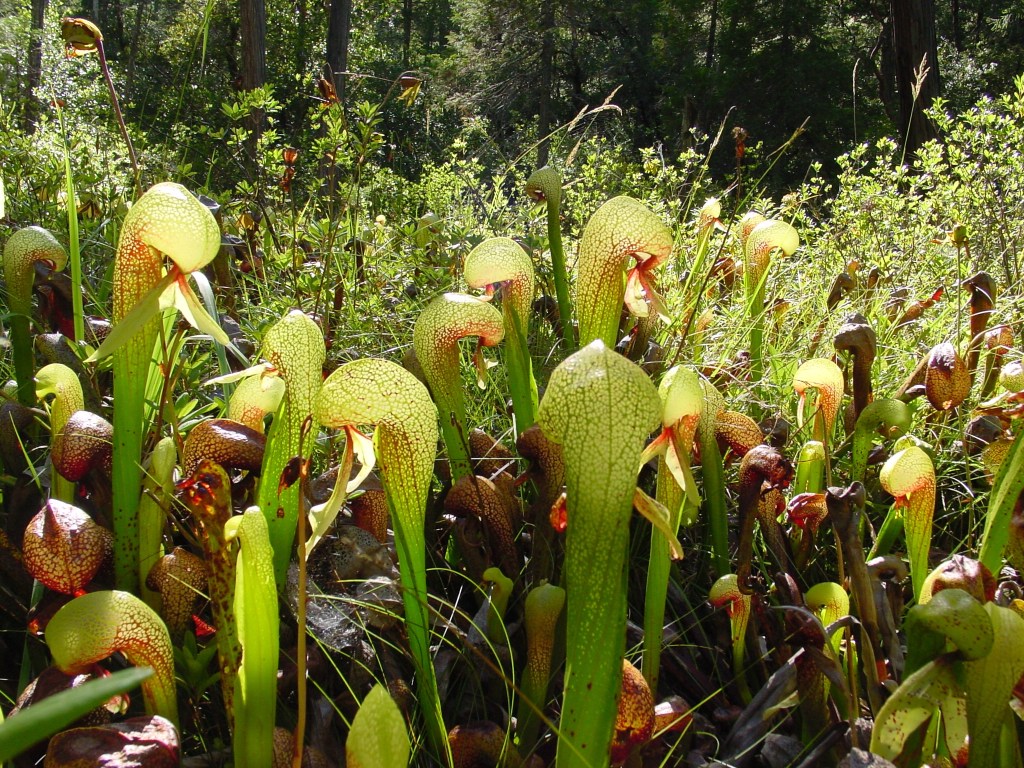
Darlingtonia californica Serpentinite Wetlands and Fens
California pitcher plant (Darlingtonia californica), a member of the relict Sarraceniaceae family and sole species of the genus Darlingtonia, is a carnivorous aquatic plant endemic to cold temperature wetlands of northwestern California and southwestern Oregon. The slopes and lowlands of the cool, moist western Klamath Mountains is the epicenter of Darlingtonia’s range.
Darlingtonia californica is not endemic to serpentinite or ultramafic soils, but it thrives on them, occupying spring, seeps, and bogs, known as wetland terraces, throughout its range. Darlingtonia’s distinct, statuesque pitchers dominate their wetland landscapes, growing up to three feet tall, and present a striking translucent green to reddish-brown silhouette.
Darlingtonia terrace wetlands are large serpentinite fen complexes occurring in the coastal Klamath Mountain regions at an average elevation of 1800 feet. Fen complex geomorphology forms as seeps saturate slumped and relatively flat serpentinite clay topography. Serpentinite terrace fens are maintained with 80-120 inches of precipitation annually, and most counter-intuitively, requires intermittent wildfire to clear out the surrounding woody vegetation and to regenerate the water table of the fen.
Similar to the waterways at The Cedars affected by ultramafic and metamorphic geochemical processes, the waters of Darlingtonia serpentinite terrace fens fall within the high pH range. As a result, these serpentinite wetlands host an array of rare and endemic plant species as well as rare microbial fauna.
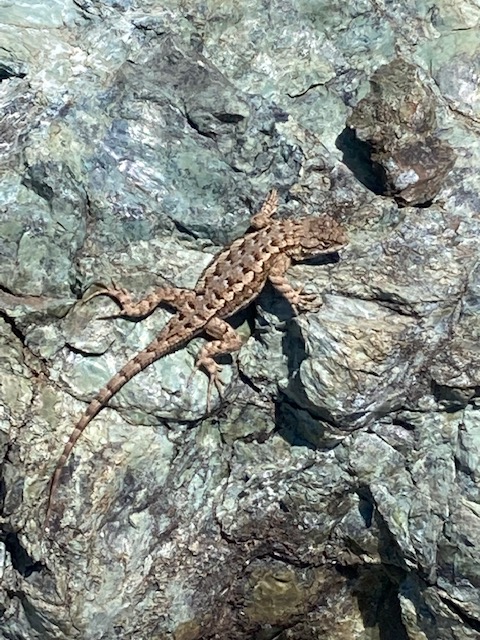
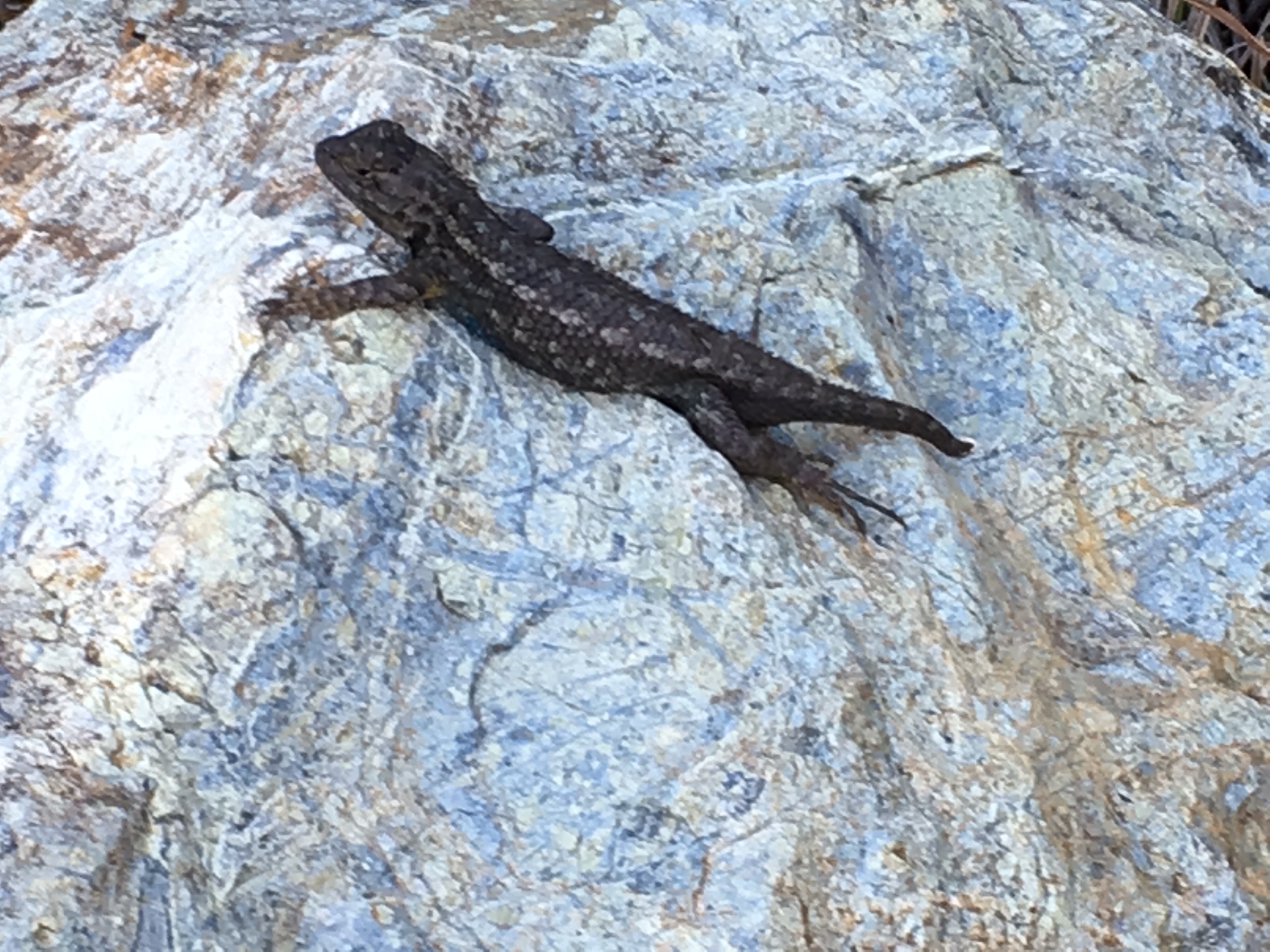
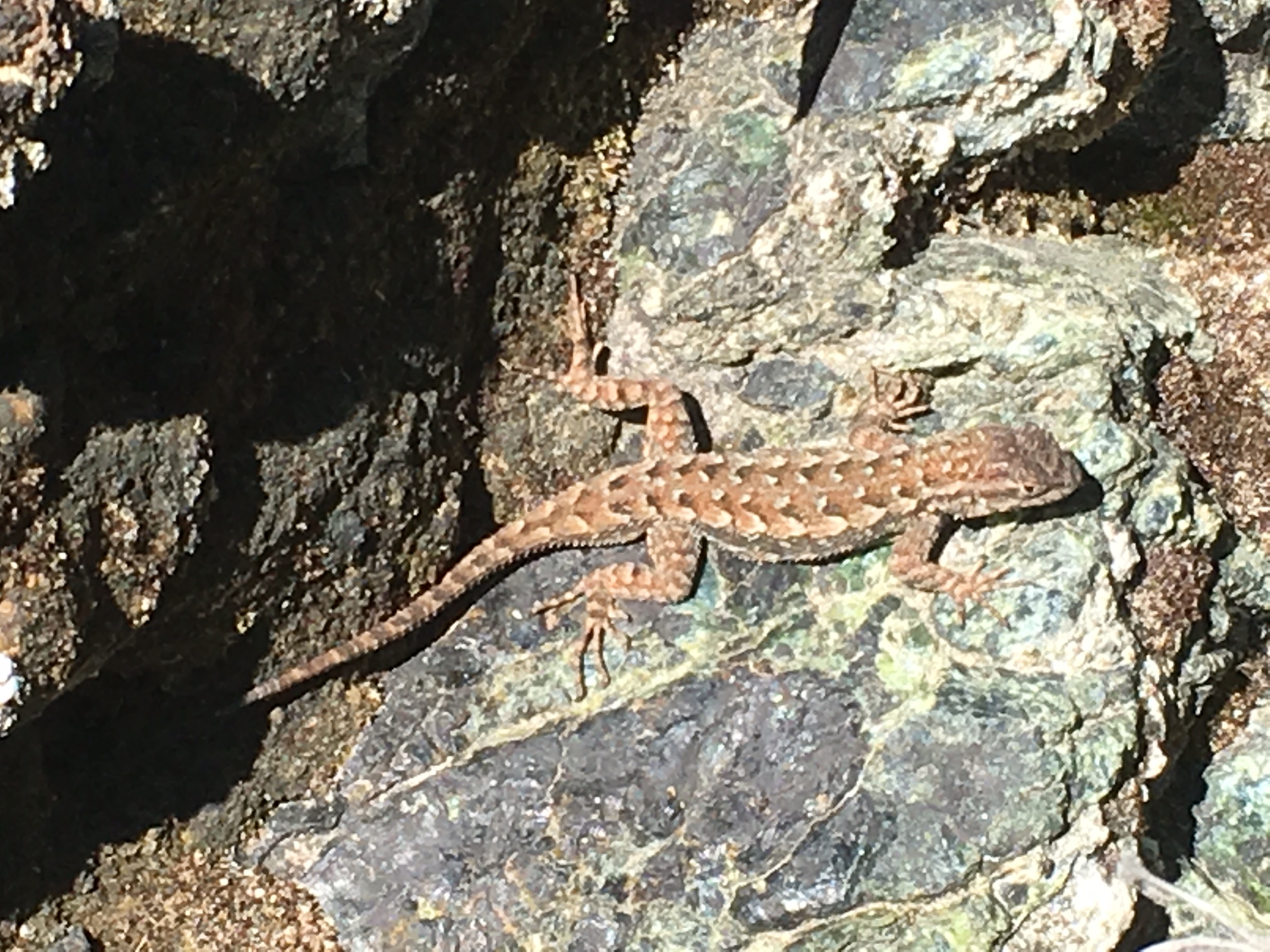

Fence lizards on Serpentinite, R. Forest
Online Resources
Calflora – Rare and endemic serpentinite plants of California
The Cedars – Info and endemic plant list – Fremontia
Serpentinite plants of the Klamath Mountains
Plants of the Darlingtonia terrace fens
References
Barbour, Michael, T. Keeler-Wolf, and A Schoenherr. 2007. Terrestrial Vegetation of California. Berkeley: University of California Press.
Benson, Shelly. 2018. “Ring Mountain Preserve Grassland Survey Map.” Marin County Parks
Blake, Clark M., et al. 2016. “The Cedars Ultramafic Mass, Sonoma County, California.”
U.S. Geological Survey Open-File Report 2012–1164
DeMoss, Jason. 2014. “Utilizing Indicator of Reduction in Soils Tubes to Affirm a Serpentinitic Hydric Soil on the California Central Coast.” California Polytechnic State University
Eckert, Andrew, Melissa L, Eckert. 2007. “Environmental and ecological effects on size class distributions of Foxtail Pin (Pinus balfourniana, pinaceae) in the Klamath Mountains, California.” Madroño 54(2):117-125 https://doi.org/10.3120/0024-637(2007)
Eckert, Andrew, Melissa L, Eckert. 2010. “Effects of historical demography and ecological context on spatial patterns of genetic diversity within foxtail pine (Pinus balfouriana; Pinaceae) stands located in the Klamath Mountains, California.” American Journal of Botany 97(4):650-659 https://doi.org/10.3732/ajb.0900099
Jimerson, T. M., et al. 1995. “A Field Guide to Serpentine Plant Associations and Sensitive Plants in Northwestern California.” USDA Forest Service, Pacific Southwest Region, R5-ECOL-TP-006.
Kruckeberg, A. R. 1999. “Serpentine barrens of western North America.” Savannas, Barrens, and Rock Outcrop Communities of North America. Cambridge University Press: 309-321.
Ledig, F.T. 2001. “Genic diversity, genetic structure, and biogeography of Pinus sabiniana.” Journal of Diversity and Distributions 5(3):77-90
https://doi.org/10.1046/j.1472-4642.1999.00037
Lee, Brad. D., et al. 2004. “Pedogenesis in a wetland meadow and surrounding serpentinitic landslide terrain, northern California, USA.” Geoderma 118(3-4):303-320
Martin, Miranda, et al. 2021. “Population and community-level impacts of increased fire frequency in serpentine chaparral.” CEC Research 5(1):1-7
Milich, K.L., et al. 2012. “Seed Viability and Fire-Related Temperature Treatments in Serotinous California Native Hesperocyparis Species.” Fire Ecology 8: 107–124 https://doi.org/10.4996/fireecology.0802107
Mooney, Harold and Erika Zavaleta. 2016. Ecosystems of California. Oakland: University of California Press.
Morrill, P.L., et al. 2013. “Geochemistry and geobiology of a present-day serpentinization site in California: The Cedars.” Geochimica et Cosmochimica Acta 109: 222–240
Raiche, Roger. 2009. “The Cedars: Sonoma County’s Hidden Treasure.” Fremontia 37:2.
Safford, Hugh, Susan Harrison. 2004. “Fire effects on plant diversity in serpentine vs sandstone chaparral.” Ecology 85(2): 539–548
Safford, H.D., et al. 2005. “Serpentine endemism in the California flora: a database of serpentine affinity.” Madrono 52(4):222-257
Sánchez-Mata, D., et al. 2016. “Mediterranean Ultramafic (Serpentine) Chaparrals of California (USA): A Geobotanical Overview.” Geobotany Studies https://doi.org/10.1007/978-3-319-21452-8_11
Stromberg, Mark R., et al. 2007. California Grasslands: Ecology and Management. Berkeley: University of California Press.
Discover more from Cal Geographic
Subscribe to get the latest posts sent to your email.
