
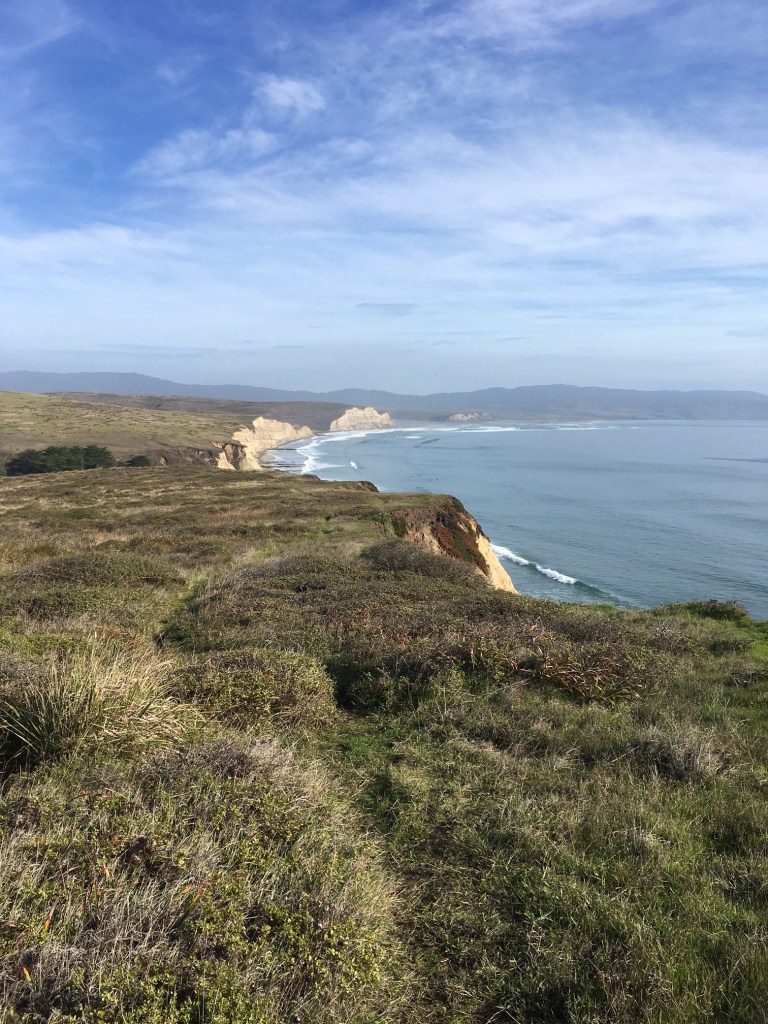
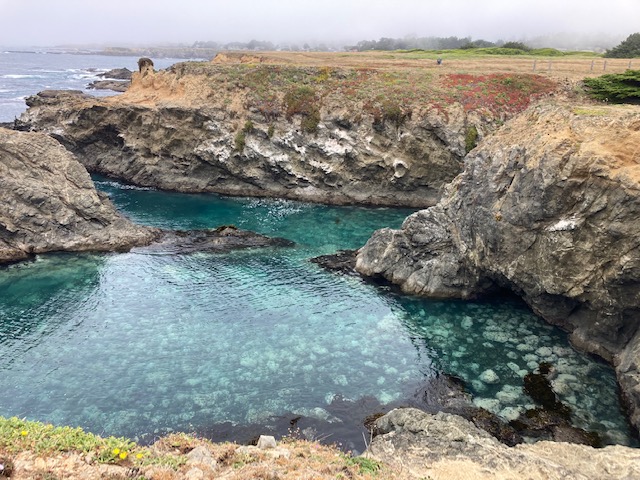
Marine terraces are a defining geomorphological feature of the West Coast, and are dispersed along the entire extent of California’s active, uplifting coastline. Found on emergent tectonic coastal margins worldwide, marine terraces underlay much of California’s heavily developed and populated regions.

Terrace Geomorphology: Tectonics and Sea Level Change
Marine terraces begin as wave cut platforms, which are wave-scoured and flattened bedrock plains of the nearshore bathymetric zone. The dominant tectonic influences California’s San Andreas Fault system and the Cascadia subduction zone provide steady and relatively swift uplift of the continental edge, exposing the nearshore platforms as emergent terraces.

The frequent and cyclic sea level transgressions and regressions of the Pleistocene and Holocene sculpted (and continue to sculpt) multiple series of terraces, which are conveyed like an escalator by steady tectonic uplift, and present a stair-stepped ascendant landscape along the foot of the Coast Ranges. As uplift progresses, the marine terraces ascend to higher elevations and further from the coastline as they age. While the oldest terraces are found the furthest inland, they do not demark historic sea levels.


Sea level rise and fall, and tectonic uplift do not occur at a steady rate. As sea level fluctuations occurred more rapidly during glacial and interglacial periods of the Cenozoic, marine terraces were formed more rapidly – some only 40,000 years apart – and result in truncated terrace plains, and compacted rasas seen on the landscape today. Terraces formed during long-duration sea level intervals can be 100,000 years apart in age, or longer, and form broad, extended coastal plains.
Differential Uplift Along a Transverse Margin
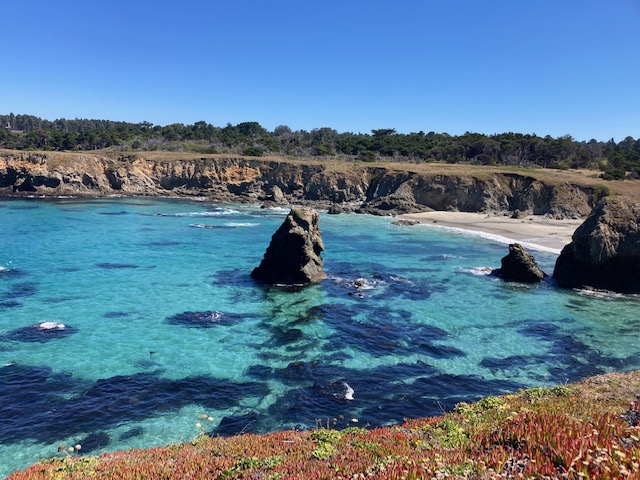
The San Andreas Fault system is a transform boundary of the North American/Pacific plate tectonic contact zone, but areas of transtension and transpression do develop along the strike-slip margin, where portions of the plates either pull apart from eachother, or collide and buckle. These areas produce additional faulting, often in lateral contact with the dominant transverse faults, as they take up or relieve pressure from the stretching or crumpling of the transform complex. It is this differential pressure, and especially the transpressional forces, that cause the uplift of the coastal margin in California, forming the Coast Range, along with the marine terraces at its base.
Due to differential uplift, folding, faulting, and warping of the crust, marine terraces of a single age can be found at different elevations along the coast. Some terraced areas of the coast may feature only one marine terrace level, while other regions hold as many as 25 visible terraces, as on the Channel Islands. Some of the oldest and highest marine terraces on the Channel Islands date to approximately two million years of age.
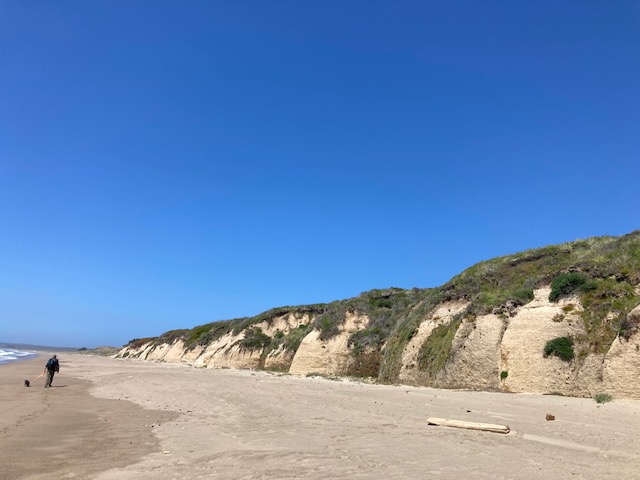
Marine Terraces are studied to determine rates of tectonic uplift, as well as to measure and confirm historic cycles of eustatic sea level regressions and transgressions. For instance, marine terraces along the Point Reyes Peninsula have been analyzed using luminescence aging methods and spatial hillslope gradient distributions, to reveal that the youngest terrace was formed during the marine isotopic stage 5a (MIS 5a) transgression/high stand around 80,000 years ago, and that the southern portion of the peninsula is rising at a much faster rate than the rest of the peninsula, due to transpression at opposing faults of the San Gregorio fault zone. (Grove et al, 2010).
Marine terrace uplift rates measured across California range from <.1 meters of uplift every thousand years, to over five meters of uplift every thousand years in highly active tectonic zones, such as the Transverse Ranges, and within the vicinity of the Mendocino Triple Junction.
Aging Marine Terraces
Marine terraces ages are measured by various techniques, such as correlating landmass and elevations with indicator fossil beds and faunas; dating bio-mineralogical materials of preserved shellfish within the terrace by using uranium series dating and acid geochronology tests; by inventorying cosmogenic radionuclide isotopes; by analyzing oxygen isotope stratigraphy; through optically-stimulated luminescence of marine sediments; and through the study of terrace soil development.
Marine terraces along the California coastal zone have been dated to a span of roughly 45 thousand years of age, to over two million years old.
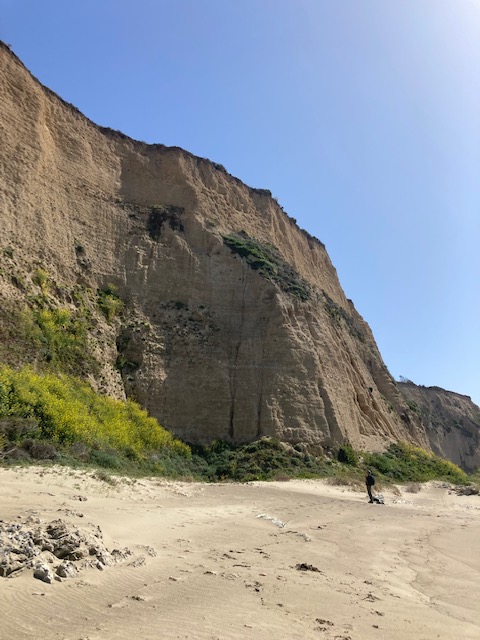
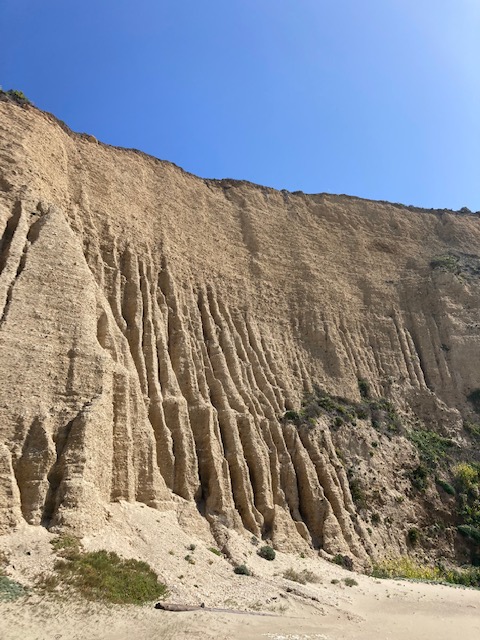
Rapidly uplifting and tilted friable terraces southern Point Reyes Peninsula, R Forest
Geology of Marine Terraces
Broadly, the geology of California’s marine terraces reflects which tectonic plate they form from, or which side of the San Andreas Fault system they reside. While marine terrace geology of the Pacific plate is often younger, softer, more friable sedimentary material, marine terraces on the North American plate (north of Pacifica/San Francisco) can develop from older, and often harder Franciscan Formation material.
The majority of the coast of California is part of the Pacific Plate, and dominated by younger sedimentary complexes of sandstones, mudstones, silt stones, and shale, as well as conglomerates and breccia. Along the Point Reyes Peninsula and the Central California coast marine terraces are formed from the very young and friable Merced Formation, the Monterey Formation dominated by highly brittle Monterey Shale, and sandstone complexes such as the Purisima Formation, Santa Cruz mudstone, and Santa Margarita mudstone.
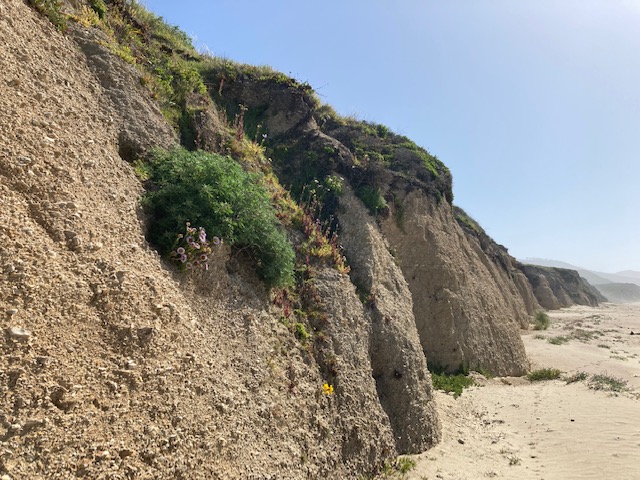
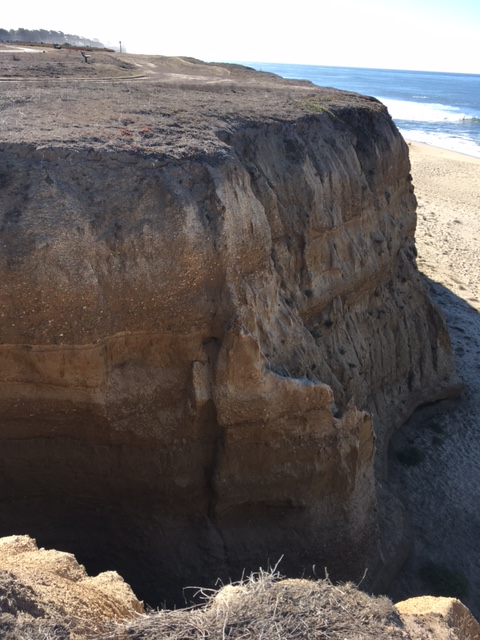

Central and Southern coast marine terraces of sandstone and conglomerate, R Forest
Further south, Santa Barbara Sandstone and loosely consolidated marine sandstone and siltstone deposits dominate marine terrace formation in the coastal region north of the Southern California Bight. Then as you travel south, the depositional sedimentary complexes of the Capistrano Sandstone complex, the Torrey Sandstones, the San Diego complex, and more breccias comprise southern California’s marine terrace geology.


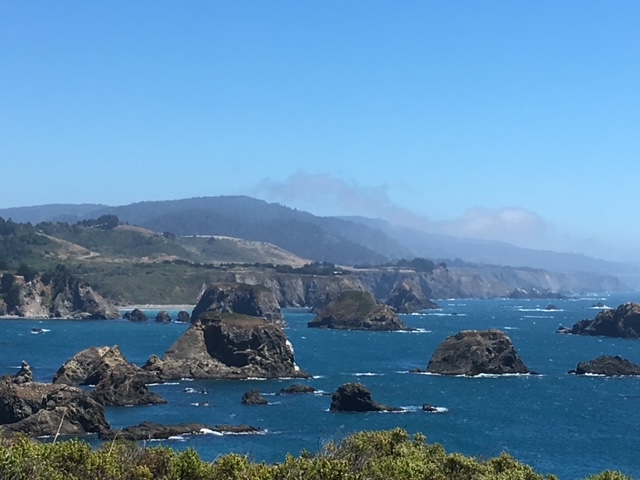
North Coast marine terraces of Greywacke bedrock, R Forest
At the foot of the Coast Ranges along California’s rugged north coast, North American plate and subduction zone/acretionary wedge geology underlays the marine terrace strand. These well-defined northern marine terraces are built mostly from lightly metamorphosed sedimentary Greywacke bedrock, overlain by younger Pleistocene and Holocene marine deposits and sandstones. Some flights of North American plate marine terraces along the Sonoma coast are formed from precipitous blue-green outcrops of extremely friable metamorphic serpentinite.

all photos by Rowena Forest
References
Anderson, Suzanne, et al, 2010. Geomorphology: the Mechanics, and Chemistry of Landscapes. Cambridge: University Press.
Grove, K., et al. 2010. “Accelerating and spatially-varying crustal uplift and its geomorphic expression, San Andreas Fault zone north of San Francisco, California.” Tectonophysics 495: 256–268
Harden, Deborah. 2004. California Geology. Upper Saddle River: Pearson
Inman, D.L. et al. 2003. “Modeling platforms, terraces and coastal evolution.” Scripps Institution of Oceanography
Larry D. Gurrola, L.D., et al. 2014. “Tectonic geomorphology of marine terraces: Santa Barbara fold belt, California.” GSA Bulletin 126: 219–233
Muhs, D.R., et al. 2022. “MIS 5e sea-level history along the Pacific coast of North America.” Earth Systems Science Data 14: 1271–1330
Muhs, D.R., et al. 2021. “A complex record of last interglacial sea-level history and paleozoogeography, Santa Rosa Island, Channel Islands National Park, California.” U.S. Geological Survey
Munster, J. et al. “Physical Data of Soil Profiles Formed on Late Quaternary Marine Terraces near Santa Cruz, California.” U.S. Geological Survey
Pedoja, K., et al. 2014. “Coastal staircase sequences reflecting sea-level oscillations and tectonic uplift during the Quaternary and Neogene.” Earth-Science Reviews 132: 13–38
Perg, L.A., et al. 2001. “Use of a new 10Be and 26Al inventory method to date marine terraces, Santa Cruz, California, USA.” Geology 29: 879–882
Discover more from Cal Geographic
Subscribe to get the latest posts sent to your email.
