
Geomorphology in action! Sinkhole, anyone? A startling site while hiking out on the mesa grasslands, even for this lifelong CA coastal hiker and geologic explorer. I have never seen a seepage-cut depression this large and deep; cut down through the bedrock; this far from the shoreline; and apparently not influenced by human drainage/irrigation debacles.

Surging, crashing ocean waves are coming in through that cave in the bottom dozens of meters from the shoreline! Instead of being formed top-down from the accompanying wetland, I suppose it is being formed from the bottom up as the ocean cuts deeper through a submerged weakness in the rocky toe of the marine terrace. There is no apparent exposed cave or crevasse entry on the ocean side, so the channel is completely submarine. Truly awesome. And check out that soil profile.

Cutting across the center of the prairie at Spring Ranch from north to south in a broadly curving arc, is a dramatic step in elevation resembling a wide scarp. At first look a seasoned coastal hiker or resident might recognize the abrupt hillslope as a slumping section of coastline experiencing destabilization and landslide-type earth movement. Heading west on the terrace at Spring Ranch toward the ocean the scarp is an abrupt downdrop in the landscape; and hiking east the scarp presents a short and steep ascent back to the level prairie at the ranch buildings and highway.

At a closer look, this slope appears to represent the ancient wave cut cliff face, between marine terrace #1 and terrace #2 along this section of the Mendocino coast. This site is within minutes of Van Damme State Park to the south and Jughandle State Park to the north, both protecting and interpreting flights of up to five distinct marine terraces, as well as ultra-rare Pygmy Forest Reserve ecosystems, which only exist atop these ecological staircases.
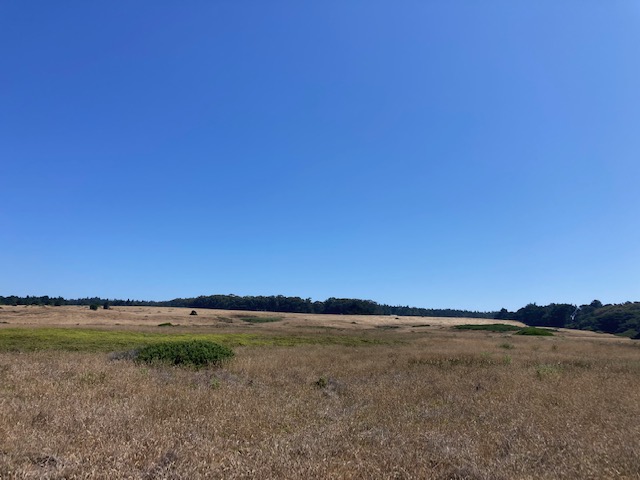

I’m excited by the possibility of this particular stair step in the lower flight of the marine terraces, because it is so accessible and visible (the well-known ecological staircases in the area are heavily forested and the tell-tale stair-stepped landform is usually not visible from any distance). And it is such a dramatically sweeping example of our active, emergent coastal tectonics.
One more curious geomorphological feature in this area of the north coast are mini terraces we observe along the rocky shoreline face of marine terrace #1.

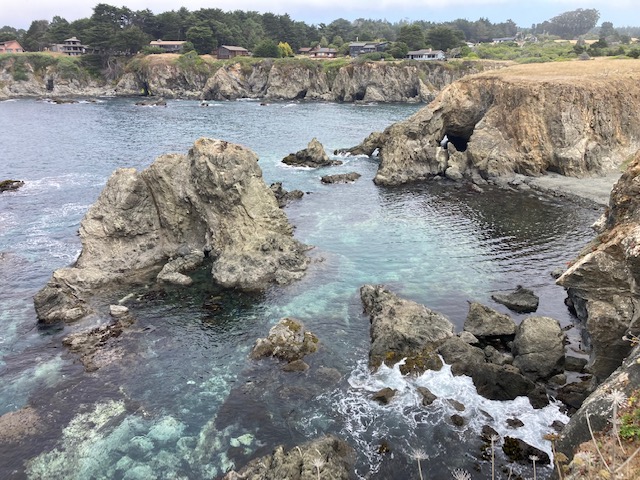
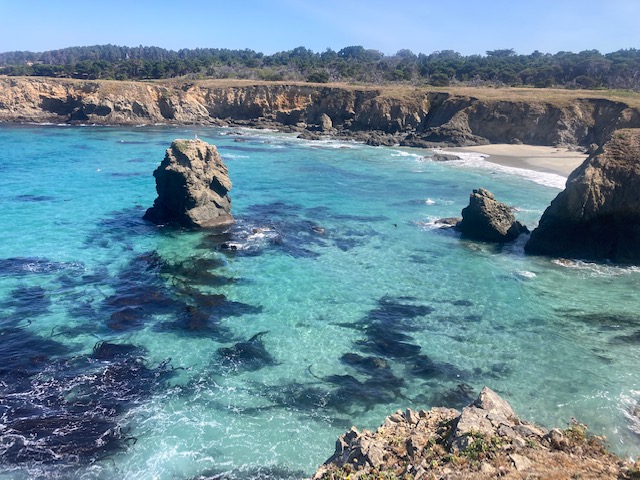
The geologic building blocks of the immediate coastal margin and marine terraces in northwestern Mendocino are of North American plate geology – and mostly underlain by Greywacke bedrock. This older, harder Cretaceous sandstone produces multitudes of signature north coastal landforms such as seastacks and islets peppering the coastline; and low rocky cliffs honeycombed with caverns, grottos, blow-holes, tunnels, and sea arches.

The low-sloping and exceedingly craggy rocky shoreline here resembles a moonscape, or that of a cooled and barren lava bed. And much of this coastal zone is carved into rocky stair-stepped benches, which mirror the much broader and higher marine terraces in the area.

R Forest
We wonder if these steps are mini marine terraces that are experiencing/displaying tectonic uplift, but eroding more quickly in the immediate erosional surf zone. And if they are being carved by the large scale global sea level regressions and transgressions, or by shorter-scale climatic events such as stormier winter series, which produce greater wave erosion and temporarily raise sea levels as well. Or perhaps these mini terraces are massive layers of stratified greywacke eroding along the bedding planes in a stair-stepped morphology.
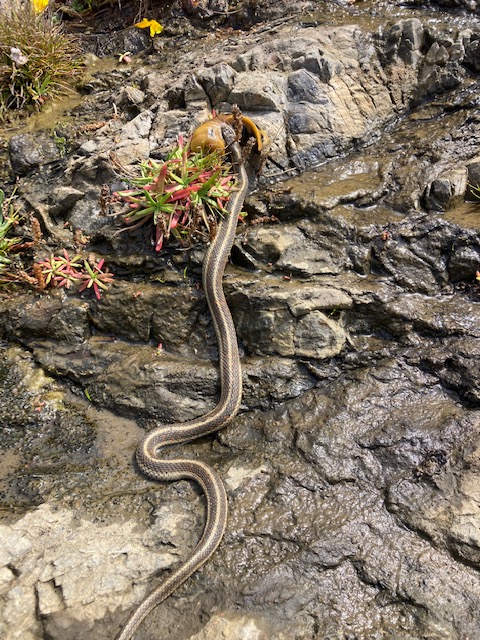

Birds, insects, crustaceans, gastropods, and even reptiles and amphibians have all carved out niches in this harsh, yet fertile, rocky shoreline landscape, which future Cal Geo posts will explore.
Discover more from Cal Geographic
Subscribe to get the latest posts sent to your email.
