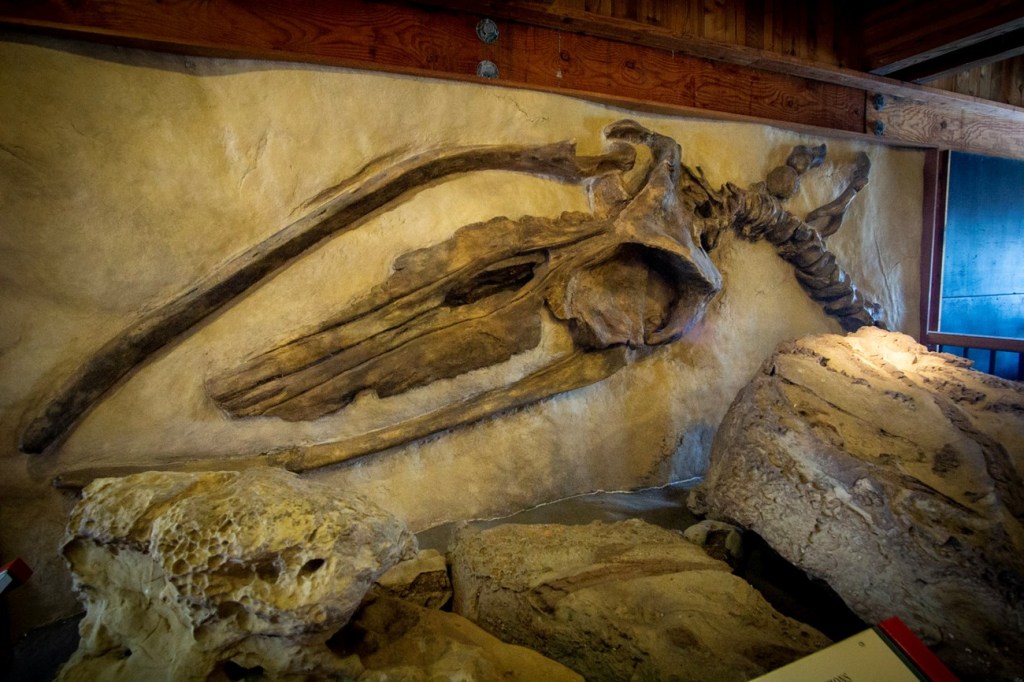
As an ode to my natal beach, which has recently and unfortunately made the news for being closed to public access indefinitely due to sewage contamination, I’m taking a look back at a happier time for this spot on the southern tip of the Point Reyes Peninsula, and the discovery of the lone specimen of a six million year old whale.

The fossilized bones of Parabalaenoptera baulinensis were found jutting from the Santa Cruz Mudstone cliffs of the Bolinas Point marine terrace in 1976 by a sharp-eyed marine biologist associated with the legendary College of Marin Bolinas Marine Station.


The find would take ten years to retrieve as wave action and tides allowed limited access to the steep and crumbling cliffs along this thin strip of isolated beach bordered by Duxbury Reef and a 100 foot-high marine terrace. The site was regularly monitored by College of Marin students and staff for newly exposed pieces of the fossil as the friable cliffs of Santa Cruz Mudstone crumbled around it, and the whale was methodically excavated bit by bit.

The decade-long processing and reconstruction of the holotype fossil of Parabalaenoptera baulinensis was completed in 1986 at College of Marin lab facilities in Kentfield, Marin County, and included fossilized material from much of the skull, both dentaries, vertebrae, pectoral limb bones, and ribs. The examining paleontologists estimate this whale species was approximately 10 meters long when swimming the late Miocene oceans, and by analyzing biomineralogical remains of diatoms found in the surrounding matrix of Santa Cruz Mudstone, the fossil was dated to between six to 6.8 million years old.

Due to the completeness of the recoverable fossil remains, Parabaleanoptera baulinensis was confidently described as an ancient genus and species new to science. And based on several distinct “primitive” physiological traits that differ from other Baleanopterids, P baulinensis was also assigned to a new subfamily of Balaenopteridae, the Parabalaenopterinae.
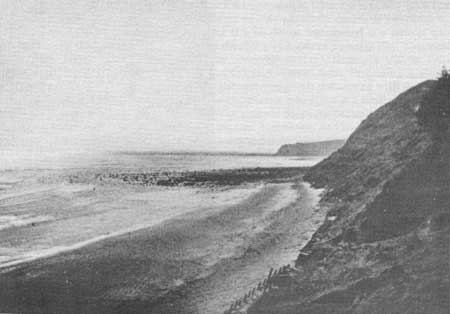

P Pyle
With the discovery of Parabalaenoptera baulinensis at Bolinas Point in 1976, followed by the reporting of a possible dugongid sea cow fossil in 1978 (found in 1972 in the vicinity of the whale fossil), and bolstered by the analysis of surrounding index fossils, the dominant geologic unit of the region which had long been assumed to be of Monterey Formation, was newly identified as the younger Santa Cruz Mudstone. Two significant simultaneous geologic and taphonomic findings for Bolinas Point and the terraces of the southern Point Reyes Peninsula.
References:
Zeigler, CV., et al. 1997. A new late Miocene Balaenopterid whale (Cetacea:Mysticeti), Parabalaenoptera baulinennsis, (new genus and species) from the Santa Cruz Mudstone, Point Reyes Peninsula, California. Proceedings of the California Academy of Sciences 50(4): 115-138.
Clark, J, and Earl E. Brabb. 1997. Geology of the Point Reyes National Seashore and Vicinity, Marin County, California: A Digital Database. USGS
Discover more from Cal Geographic
Subscribe to get the latest posts sent to your email.
