Welcome to the Cal Geographic Report – We look forward to sharing news and updates of the biogeography and geomorphology of California’s living landscapes.
This almost vernal equinox podcast episode is totally dedicated to California’s seasonal freshwater wetlands and vernal pools.
We will review several of California’s regional vernal pool complexes and preserves across the state, and highlight those with public access and upcoming spring vernal pool tours. We will also highlight a few recent scientific studies that focus on the biogeography of California’s seasonal wetlands and vernal pools. Links and citations to all of the topics and papers can be found on the transcript of this episode of the Cal Geographic Report, on CalGeographic.com. Thanks for tuning in!
~~~~~~~~~~~~~~~~
Let’s start with a quick introduction to California’s seasonal wetlands and vernal pools:
Seasonal freshwater wetlands are intermittent and temporary aquatic habitats with short inundation phases (or seasons) replenished by winter rains, and longer phases of drying out and desiccation. The length of time and physical conditions of the wetland inundation phase varies from year to year depending on annual precipitation. One defining factor shared by all seasonal wetland types in California is the wet-dry Mediterranean climate cycle, which has produced the extreme seasonality these ephemeral ecosystems have so beautifully adapted to. Seasonal freshwater wetlands host unique emergent flora and fauna communities evolved to tolerate (and depend on) the cycle of inundation and desiccation.
There are two broad types of seasonal freshwater wetlands in California based on geomorphology: seasonal saturation wetlands, and vernal pools.
Once found widespread across the marine terraces and lowlands of California’s coastal zone and Coastal ranges, seasonal saturation wetlands are arguably the most overlooked, underappreciated, understudied, and endangered freshwater wetland types in the state. Once abundant, coastal seasonal wet meadows, pools, and swales were (and are) key ecosystem components within the highly endangered coastal scrub and coastal prairie ecotypes of the West Coast. Overwhelmingly impacted by human disturbance and development, coastal seasonal saturation wetlands have been eliminated by an estimated 98%.
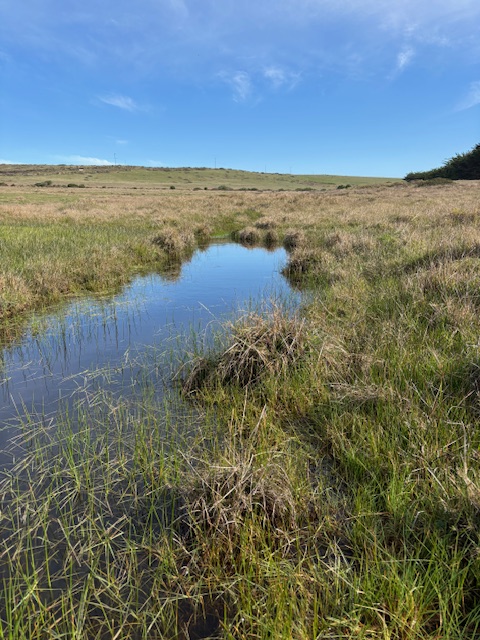
In contrast to the well-known valley hardpan vernal pools of the Central Valley and elsewhere in the state, which develop and hydrate in wet months by retaining rainwater above an impermeable hardpan or claypan substrate, seasonal saturation wetlands usually form when high subsurface water tables completely saturate and overflow the more permeable soils of the coastal sedimentary complexes and Franciscan Formation in the winter and spring months. These coastal wetlands commonly present as puddles, wet meadows, and trickling seeps and swales on marine terraces.
California’s vernal pools, found throughout the Central Valley, the San Diego region, and flood plain basins in the inner Coast range, are unique hydrological systems formed as shallow depressions over an impermeable subsurface hardpan or claypan, which accumulate and retain water directly from precipitation, and dry out by evaporation.
You can read our in-depth articles covering the biogeography and geomorphology of California’s Seasonal Wetlands on Cal Geographic.com and linked here on the show transcript
~~~~~~~~~~~~~~~~
Here is an overview of California’s major seasonal wetland and vernal pool preserves from north to south, which are open to the public, and some that offer spring vernal pool tours. You can find links to all the information for these sites like public access and tour information on the transcript for this podcast on our website, CalGeographic.com:
The Vina Plains Preserve is north of Chico in the northeastern Sacramento Valley: Each spring at the Vina Plains Preserve, The Nature Conservancy hosts seasonal walks featuring wildflowers and rare invertebrates that inhabit vernal pools. This spring, the Vina Plains Preserve will have an event focused on the preserve’s rare vernal pools and a second event focused on documenting biodiversity with iNaturalist. Walks will take place on Saturday March 28 and Saturday April 25 from 9:00 a.m. to 11:30 a.m. Registration is required.
North Table Mountain Ecological Reserve and Vernal Pools is just north of Oroville, also in the northeastern Sacramento Valley, and at the base of the Sierra foothills: The California Department of Fish and Wildlife’s North Table Mountain Ecological Reserve is a basalt mesa formed from ancient lava flows at the base of the foothills of the Sierra Nevada, which is known for abundant spring wildflowers and rare Northern Basalt Flow Vernal Pools. This type of vernal pool develops over an impermeable layer of basalt that holds inundation from winter rains. Throughout the Reserve the porous and fissured basalt landforms funnel water from winter rains into abundant streams and dramatic waterfalls trailing off the edges of the plateau. Purchase of a Landpass is required for day use entry to the reserve.
Loch Lomond Vernal Pool Ecological Reserve, near the town of Loch Lomond in Lake County: This 13-acre reserve serves to protect sensitive vernal pool plant species. It is situated in a large basin in the Mayacmas Mountains at an elevation of 2,800 feet. The vernal pool is classified as a Northern Volcanic Ash type, and supports a wide variety of plant species that are restricted to vernal pool habitats.
Prairie City North Vernal Pool Management Area and spring tours, east of Sacramento near Rancho Cordova: Prairie City North Vernal Pool Management Area will hold vernal pool tours on four Saturdays, March 14 & 28, April 11 & 25 at 10 a.m. and 1 p.m. Space is limited, so please sign up ahead. The tours will include an easy to moderate walk introducing the secrets of survival in a mysterious landscape. Topics include pool formation, types of plants and animals, Mima mound theories and their adaptations for survival.
Tours are offered on four weekends this spring at Mather Field Vernal Pools, also adjacent to Rancho Cordova.
Mead Ranch Vernal Pools and tour in Napa Valley: On May 9th the Napa Land Trust is leading a hike through the historic Mead Ranch in the hills northeast of Napa to view vernal pools and wildflowers – a fleeting glimpse into one of California’s most unique natural habitats. Please register ahead.
Laguna de Santa Rosa Wildlife Area and vernal pools on the Santa Rosa/Russian River flood plain in central Sonoma County: The 30,000 acre Laguna de Santa Rosa Wetland Complex is composed of seasonal and perennial freshwater wetlands such as creeks, ponds, marshes, vernal pools, swales, floodplains, riparian forest, and grassland within the Laguna de Santa Rosa Watershed. The Santa Rosa Plain, situated at the heart of the Laguna de Santa Rosa watershed, is a vast oak savannah grassland, dotted with vernal pools. The Santa Rosa Plain (SRP) has lost 85% of its vernal pools within the last 50 years due to urbanization and intensive agriculture. The Laguna Foundation’s conservation program includes research, restoration, and active management of vernal pools within the complex.
Jepson Prairie Vernal Pool complex is located north of the Delta near Dixon in Solano County, and hosts annual vernal pool Wildflower & Critter Walks: Join the Solano Land Trust and the docents of Jepson Prairie Preserve for the celebrated Wildflower and Critter Walks on Saturdays and Sundays from March 14 – May 10 2026.
Certified “dipper” docents will display the crustaceans and salamanders that inhabit the vast temporary pools that form above the claypan at Jepson Prairie, and will tour visitors through the millions of colorful wildflowers that grow over the uplands of the property. The Jepson Prairie Preserve and its adjacent properties compose one of California’s best and largest remaining vernal pool and native bunchgrass prairie ecosystems. Ten endangered species live on the the property, including the Delta green ground beetle, Conservancy fairy shrimp, and Solano grass. The claypan vernal pools attract migratory birds such as stilts, avocets, and snow geese.
UC Merced Vernal Pools and Grassland Preserve and spring tours at UC Merced: Adjacent to the UC Merced campus in eastern San Joaquin Valley, the 6,500-acre UC Merced Vernal Pools and Grassland Preserve is home to some of the most intact, threatened Vernal Pool wetland habitat in California and the world, and is considered a hotspot for biodiversity. Tours of the vernal pools will be held at the Preserve this spring every Friday in March and April.
The UC Santa Cruz Terrace Lands at Younger Lagoon Preserve in Santa Cruz: The UC Santa Cruz Younger Lagoon Preserve and Terrace Lands is located on and within the marine terraces at the northern border of the city of Santa Cruz. Campus facilities at the reserve include the Long Marine Lab science complex and the Seymour Marine Discovery Center. The 47 acre Terrace Lands preserve are former agricultural lands atop the terrace, which are being restored to native coastal scrub and seasonal saturation wetland habitats. The Terrace Lands are accessible via a network of public trails that are open from dawn till dusk, with views of rare coastal terrace seasonal saturation wetlands in the winter and spring.
Fort Ord National Monument and Vernal Pools in Monterey County: Fort Ord National Monument is a former military base of expansive rolling hills and lowlands formed by Pleistocene-aged stabilized dunes, in the Monterey Bay area. The Monument hosts rare ecosystems such as oak woodlands, maritime chaparral, and seasonal wetland complexes including backdune vernal pools that form within stabilized dunes atop an impermeable claypan layer. Fort Ord has an excellent public trail system, and routes with views of the vernal pools, particularly in the northern region of the monument.
Camino Corto and Del Sol Vernal Pool Preserves are small but invaluable restored marine terrace seasonal wetland complexes in the northeastern portion of the UC Santa Barbara campus in Isla Vista, and contiguous with the larger restored wetland complexes at the North Campus Open Space Reserve. This is a heavily trafficked campus trail system with views of these special wetlands in the winter and early spring.
North Campus Open Space Preserve and restored vernal pool complex at UC Santa Barbara: The North Campus Open Space Preserve is a massive restoration project at UC Santa Barbara featuring extensive tidal wetlands and marine terrace habitats including a chain of restored vernal pools, which can be observed in the winter and spring from the West Mesa portion of the Preserve. The North Campus Open Space at UC Santa Barbara has an excellent interpretive trail system and maps are readily available.
Santa Rosa Plateau Ecological Reserve Vernal Pool Trail in San Diego: The Santa Rosa Plateau Ecological Reserve in eastern San Diego has long been recognized for its significant resources, which include two historic adobes, rare Engelmann’s oak woodlands, volcanic soils harboring vernal pools, running creeks, over 200 bird species, dozens of mammal species, and more than 50 rare, threatened, or endangered plant species. A recommended hike is the Vernal Pool Trail to the adobes, which traverses a boardwalk and provides good views of vernal pools on the reserve in winter and early spring.
Miramar Community College Vernal Pools Preserve and Restoration/Conservation lands in San Diego: The Miramar Vernal Pool Preserve on the Miramar Community College campus in San Diego harbors some of the rarest and most endangered species in the United States, including San Diego Mesa Mint, San Diego Fairy Shrimp, San Diego Button-Celery, Orcutt’s Brodiaea, Campbell’s Liverwort, and San Diego Golden Star. The Miramar College Vernal Pool Preserve features an interpretive trail, and an ecosystem education and viewing area.
~~~~~~~~~~~~~~~~~
Some of the vernal pool and seasonal wetland preserves in California not open to the public and conducting ongoing restoration, monitoring, and study include: The UC Hopland Research Center in Mendocino County, the Nature Conservancy’s Dangermond Preserve at Point Conception in Santa Barbara County, Marine Corps Base Camp Pendleton in San Diego County, and Marine Corps Air Station Miramar also in San Diego County.. just to name a few. (For posting on transcript only):
UC Hopland Research Center vernal pools studies: Although most common on terrace soils bordering the east side of the Central Valley at the base of the Sierran foothills, vernal pools are scattered throughout the state on a variety of soils and land forms. Located in the rugged terrain of the Mayacamas Mountains, the U.C. Hopland Research and Extension Center (HREC) has many vernal pools within its 5,300 acres of oak woodland, grassland, and chaparral. Twelve of the larger vernal pools at HREC were studied and found to vary considerably in land form, soil type, mean area and volume, and species composition. Researchers here are currently collecting baseline data on plant and aquatic invertebrates,as well as on soil characteristics and water chemistry.
Burton Mesa, Santa Maria Basin/Santa Barbara County: The 5,186-acre Burton Mesa Ecological Reserve in western Santa Barbara County was acquired by the California Department of Fish and Wildlife to preserve the rich botanical diversity of the area, particularly within the Burton Mesa Chaparral. There are two vernal wetland areas at the Ecological Reserve, both on the west side. The northern vernal wetland area is located southwest of Cabrillo High School in the Santa Lucia Management Unit. It occurs on a gently sloping drainage that was farmed in previous years, with many weeds in the area. The southern vernal wetland area is located south of Highway 1 in the Vandenberg Management Unit. The vernal pool fairy shrimp was documented in 2004 in several vernal pools on the Vandenberg Management Unit
Dangermond Preserve (seasonal terrace wetlands): At the Dangermond Preserve seasonal wetlands dotting the expansive Cojo (marine) Terrace at Point Conception have been surveyed and classified in 2012 and again in 2025, which is a huge step in the positive direction for coastal seasonal saturation wetlands identification and recognition of their hydrologic and ecosystem function, and ultimately for their wider protections. The wetland surveys at Dangermond Preserve mapped and classified the delineated wetlands on the terrace topographically as flat wetlands, depression wetlands, swales, and spring fed swales. Vegetation surveys, habitat quality assessments, soil surveys, and Branchiopod surveys were also conducted in this delineation process.
MCB Camp Pendleton Environmental Management Vernal Pools article: Camp Pendleton is continuously maintaining vernal pool habitats in an effort to preserve the environment on base and enhance the coastal bluff overlooking the San Onofre State Beach. The base began coordinating with California State Parks and U.S. Fish and Wildlife Services during the fourth quarter of 2014, conducting habitat replacement for the San Diego Fairy Shrimp, a federally listed endangered species.There are approximately 4,000 vernal pools on Camp Pendleton. The amount of pools differ throughout the year due to changes in temperature, weather and other ecological conditions. “We try to locate and identify where the vernal pools are so we can preserve their conditions,” said Asmus. “If they’re in poor condition, we restore those pools and we conduct surveys to determine if they’re occupied by endangered plants or animals. Finally, we monitor the pools to see if their ecology changes over time.” As the base protects training areas from urban construction it also preserves ecological conditions in these areas and allows vernal pools to develop. “In the San Diego County, approximately 90 percent of vernal pools are on Marine Corps bases,” said Asmus. “The Marine Corps keeps training areas undeveloped to conserve the wildlife in those areas while maintaining operability for training.”
MCAS Miramar Vernal Pools: Marine Corps Air Station Miramar has possibly the largest and least disturbed acreage of vernal pool landscape that remains in Southern California. The San Diego chapter of the California Native Plant Society is restoring and stewarding the a portion of the Miramar Vernal Pool Preserve, which had been the site of rampant dumping and invasive species growth.
Miramar Mounds National Natural landmark on Marine Corps Air Station Miramar: The Miramar Mounds and Vernal Pools on Marine Corps Air Station Miramar is San Diego’s largest remaining area of natural vernal pools and is rarely opened to the public. Mima mound-vernal pool areas are found in only a few regions of the world outside the South Pacific Border Region in California. Nowhere else, however, are they known to be as well-developed and as biologically diverse. Of the six different types of mima mound-vernal pool areas in California, Miramar Mounds is the best example of the type located on essentially level but rocky remnants of old alluvium. The area is the type locality of the Redding complex, soils that are of special interest because of their great age and profile development. It is also one of the few remaining areas where these soils and their natural vegetation are relatively undisturbed. Within the complex botanical communities of the vernal pools are four federally endangered vernal pool plant species: San Diego Mesa Mint (Pogogyne abramsii), San Diego Button Celery (Eryngium aristulatum var. parishii), california orcutt grass (Orcuttia californica), and the federally threatened Spreading Navarretia (Navarretia fossalis).
~~~~~~~~~~~~~~~~
One of the most unique and rare vernal pool types is the Chaparral Vernal Pool, found in maritime chaparral communities in the San Diego vernal pool region, as well as at Burton Mesa in the Santa Barbara vernal pool region, and within the maritime chaparral of Fort Ord in the Monterey Bay Area. The California Chaparral Institute and the Chaparral Conservancy have described these rare wetland types, and continue to advocate for the conservation of chaparral and for vernal pools.
~~~~~~~~~~~~~~~~
And we’ll wrap up with three recent studies investigating the biogeography of species that depend on California’s seasonal wetlands:
From the paper “Multi-scale patterns in the occurrence of an ephemeral pool-breeding amphibian” our friend, Patrick M. Kleeman and authors discuss habitat concerns for the threatened Western spadefoot toad: Species distributions are governed by processes occurring at multiple spatial scales. For species with complex life cycles, the needs of all life stages must be met within the dispersal limitations of the species. Multi-scale processes can be particularly important for these species, where small-scale patterns in specific habitat components can affect the distribution of one life stage, whereas large-scale patterns in land cover might better explain the distribution of other life stages. Using a conditional multi-scale model, we evaluated which aspects of the landscape and local environment are most strongly related to occupancy patterns of western spadefoots (Spea hammondii). In northern and central California, the proportion of grassland land cover within 2 km of a site was positively related to the occurrence of the northern clade of the western spadefoot. At the pond scale, we found that western spadefoots were more likely to breed in pools with lower pH. Our results indicate that protecting remaining grasslands for adult spadefoots and ensuring multiple pools with diverse characteristics and hydroperiods so at least some pools result in successful breeding will likely be necessary to conserve western spadefoots, especially with a changing climate. Considering the processes that affect species distributions at multiple life stages and spatial scales is an essential component of effective conservation.
Halstead, B., et al. 2022. “Multi-scale patterns in the occurrence of an ephemeral pool-breeding amphibian.” Ecosphere 13(3960): 1 of 14, doi.org/10.1002/ecs2.3960
~~~~~~~~~~~~~~~~
From the paper “Invertebrate community composition differs between restored and natural vernal pools.”: The loss of freshwater wetlands worldwide has underscored the importance of restoration to enhance biodiversity and functional objectives. While aquatic invertebrate communities within restored perennial freshwaters are well studied, few studies have occurred in the greatly reduced habitat of seasonal wetlands, such as vernal pools. California vernal pools have experienced high habitat loss and support many threatened or endangered invertebrate species. We compared 90 natural and 90 restored vernal pools of different ages across 10 sites throughout California and Southern Oregon using the Sars’ method. Large branchiopod abundance, total invertebrate abundance, class richness, and community composition were assessed between pool types (natural vs. restored) and along environmental gradients (e.g. site, pool depth, surface area, age since restoration). Large branchiopod and total invertebrate abundance were 215 and 274% higher in natural pools than restored pools, but class richness was not different. Community composition was significantly different and driven by greater abundances of vernal pool fairy shrimp, San Diego fairy shrimp, Ostracoda, Cladocera, and Copepoda in natural pools. Few environmental or habitat variables explained patterns in richness or abundance. Our work demonstrates that restored pools, even those decades old, are different than natural pools. Future mitigation and monitoring guidelines for restored vernal pools should include quantitative evaluations for aquatic invertebrates. Restored pools are not adequate compensation for lost natural pools because they do not have the same ecological functions and values.
O’Brien, S.M., et al. 2024. “Invertebrate community composition differs between restored and natural vernal pools.” Restoration Ecology 32(14080), doi.org/10.1111/rec.14080
———————————————————-
From the species summary of the San Diego Mesa Mint (Pogogyne abramsii) from the California Department of Fish and Wildlife Rare and Endangered Plants Profiles page: San Diego mesa mint is a California endangered plant species, which means that killing or possessing the plant is prohibited by the California Endangered Species Act (CESA). San Diego mesa mint is also listed as endangered under the federal Endangered Species Act(external link). It is an aromatic, hairy annual herb in the mint family (Lamiaceae) restricted to San Diego County. San Diego mesa mint habitat is coastal terrace vernal pools occurring on gravelly loams called Redding soil. San Diego mesa mint has unique, bell-shaped purple flowers that typically bloom from March through June. It can self-fertilize, but produces more seeds when it is cross pollinated by its pollinators, the Eurasian honey bee and two anthophorid bees. Like most vernal pool species, San Diego mesa mint seed germination is dependent on the wet and dry cycles of vernal pools, saturated in the winter and dry for 6-8 months of the year. Individuals are typically 5-20 cm long and are often found growing alongside San Diego button-celery (Eryngium aristulatum var. parishii) and San Diego fairy shrimp (Branchinecta sandiegonensis). San Diego mesa mint was once widespread in San Diego County, spanning from Del Mar Mesa to Kearny Mesa. Urbanization has fragmented and diminished San Diego mesa mint habitat. In addition to urbanization, threats to San Diego mesa mint include alteration of wetland hydrology, off-road vehicle activity, competition with invasive species, road widening projects, illegal dumping, and military activities. Drought, climate change, and fire control are also contributing to habitat alteration. Nonnative plants were identified as the most significant threat to San Diego mesa mint in 2010 because of the competition for space and resources they create. Despite all of these threats, San Diego mesa mint has persisted since it was listed 1978. This is primarily due to conservation and restoration efforts that lead to the enhancement or creation of vernal pool complexes. In 1998, the Vernal Pools of Southern California Recovery Plan was published in collaboration by the U.S. Fish and Wildlife Service and San Diego State University. This plan outlines recovery action for six vernal pool species listed as endangered, including San Diego mesa mint. Future efforts to restore and conserve vernal pools in California, including control of nonnative plants, are needed to preserve San Diego mesa mint.
~~~~~~~~~~~~~~~~
Thank you for listening – You can find citations, links, and references for the topics covered in this episode of the Cal Geographic Report on our website – CalGeographic.com. We look forward to further explorations and investigations of the biogeography and geomorphology of California’s Living Landscapes
~~~~~~~~~~~~~~~~
Discover more from Cal Geographic
Subscribe to get the latest posts sent to your email.
